
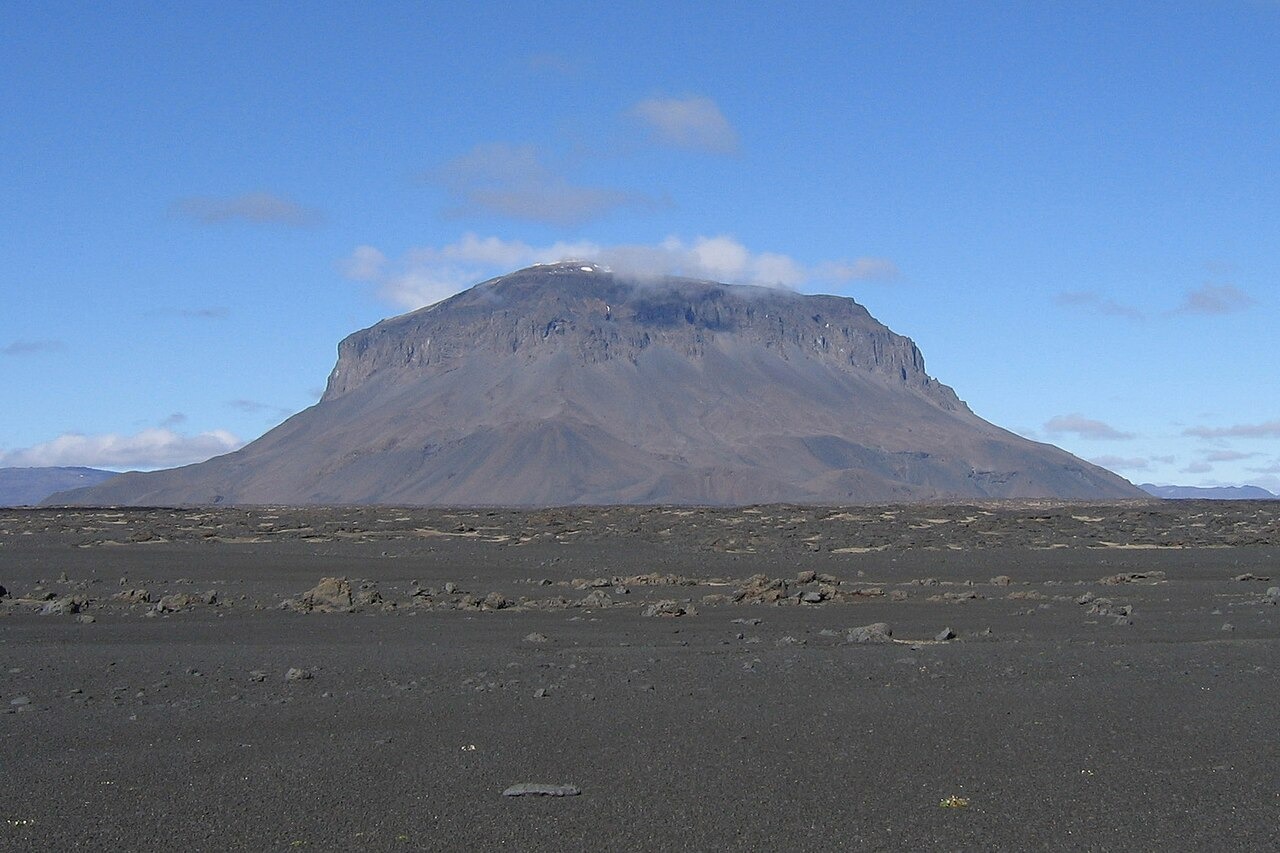
Form and Classification
Herðubreið reaches 1,682 m and presents the characteristic profile of a tuya: near-vertical flanks and a broad, flat top. The mountain is cited in the Vatnajökull World Heritage nomination as a type example of subglacial volcanic architecture in Iceland. Its isolation on the Ódáðahraun plain makes the form immediately legible from a distance. Herðubreið should not be confused with Herðubreiðarlindir, the spring oasis at its base, or with the adjacent ridge of Herðubreiðartögl.
Layered Evidence of Subglacial Growth
Research published in Jökull by Jakobsson and Guðmundsson explains the sequence of deposits that records how the mountain grew. Pillow lavas at lower elevations formed as magma cooled rapidly in meltwater pooled beneath the ice. Above these, fragmental hyaloclastite accumulated where magma shattered on contact with water. The uppermost layers are coherent lava flows, emplaced once the growing edifice reached above the meltwater level. Together the layers document eruption constrained at every stage by the geometry of the surrounding ice, with the present form exposed after the ice eventually retreated.
Compositional Stratigraphy
A study published in the Journal of Volcanology and Geothermal Research sampled successive rock layers through the edifice and identified upward changes in magma composition. These shifts reflect how the magma body evolved chemically as the eruption progressed, providing a record of the internal dynamics of the event independent of any single radiometric date. The compositional gradient adds resolution to the depositional sequence described by structural mapping, allowing researchers to correlate physical layering with magmatic history across the edifice.