
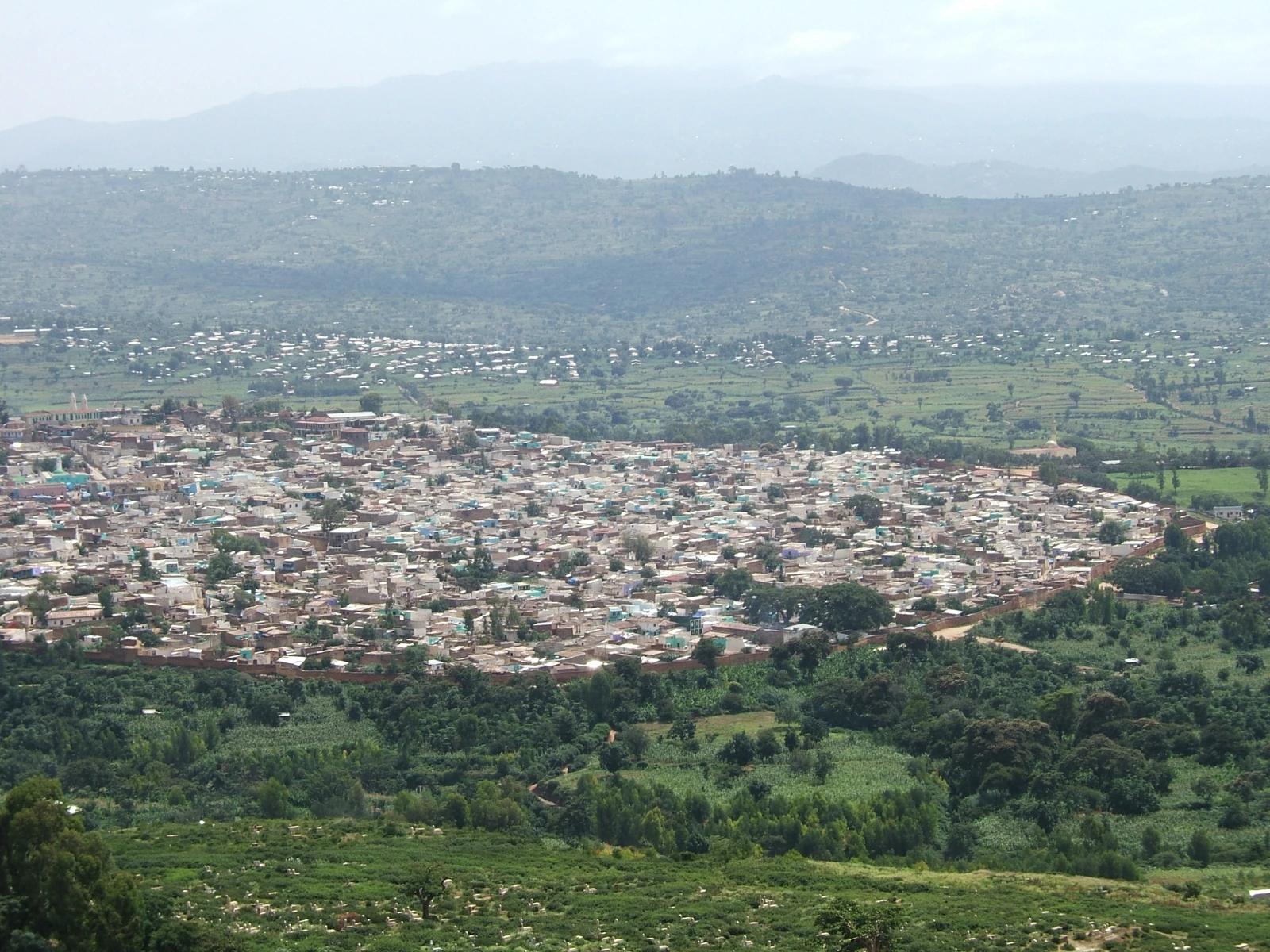
Hilltop Landform and Settled Landscape
The historic core of Harar Jugol occupies a plateau of roughly 48 hectares, stretching just over one kilometre from east to west and approximately 700 metres from north to south. The surrounding terrain drops away into deep gorges, giving way to savannah and progressively drier land beyond. This natural containment reinforced the defensibility of the site and shaped the compact urban grain visible along the wall's inner edge, where tightly spaced rooftops press close to the enclosing fortification.
Walls, Gates, and the Name Jugol
UNESCO documentation records that construction of Harar's defensive circuit took place between the 13th and 16th centuries, with the present historic boundary largely defined by the 16th-century wall associated with Emir Nur ibn al-Mujahid. The Harari word Jugol means “the wall” and also names the old town enclosed by it. Five historic gates connected the town to surrounding roads and outlying quarters; a later Harar gate is recorded separately from these original five. The city was incorporated into Ethiopia in 1887.
Archaeological Evidence Within the Walls
Khalaf and Insoll report excavations at nine locations inside or immediately beside the walls, including five mosques, a shrine, and a blacksmithing site. Radiocarbon measurements date the material collected at these sites to periods from the 15th through the 19th or early 20th century. The excavations help date activities at each location and show how worship, domestic life, and craft took place close together.
Shuwalid Festival and the Gates
UNESCO inscribed Harar Jugol as a World Heritage site in 2006 and, in 2023, added the Harari community's Shuwalid festival to its Intangible Cultural Heritage list. The three-day festival takes place at the Aw Shulum Ahmed and Aw Akebara shrines, located near two of the historic entrances to the town. It follows six days of fasting after Ramadan and brings together song, the recitation of scripture, and elders sharing traditions with younger generations. The gates through which people entered the hilltop settlement centuries ago still mark gathering places today.