
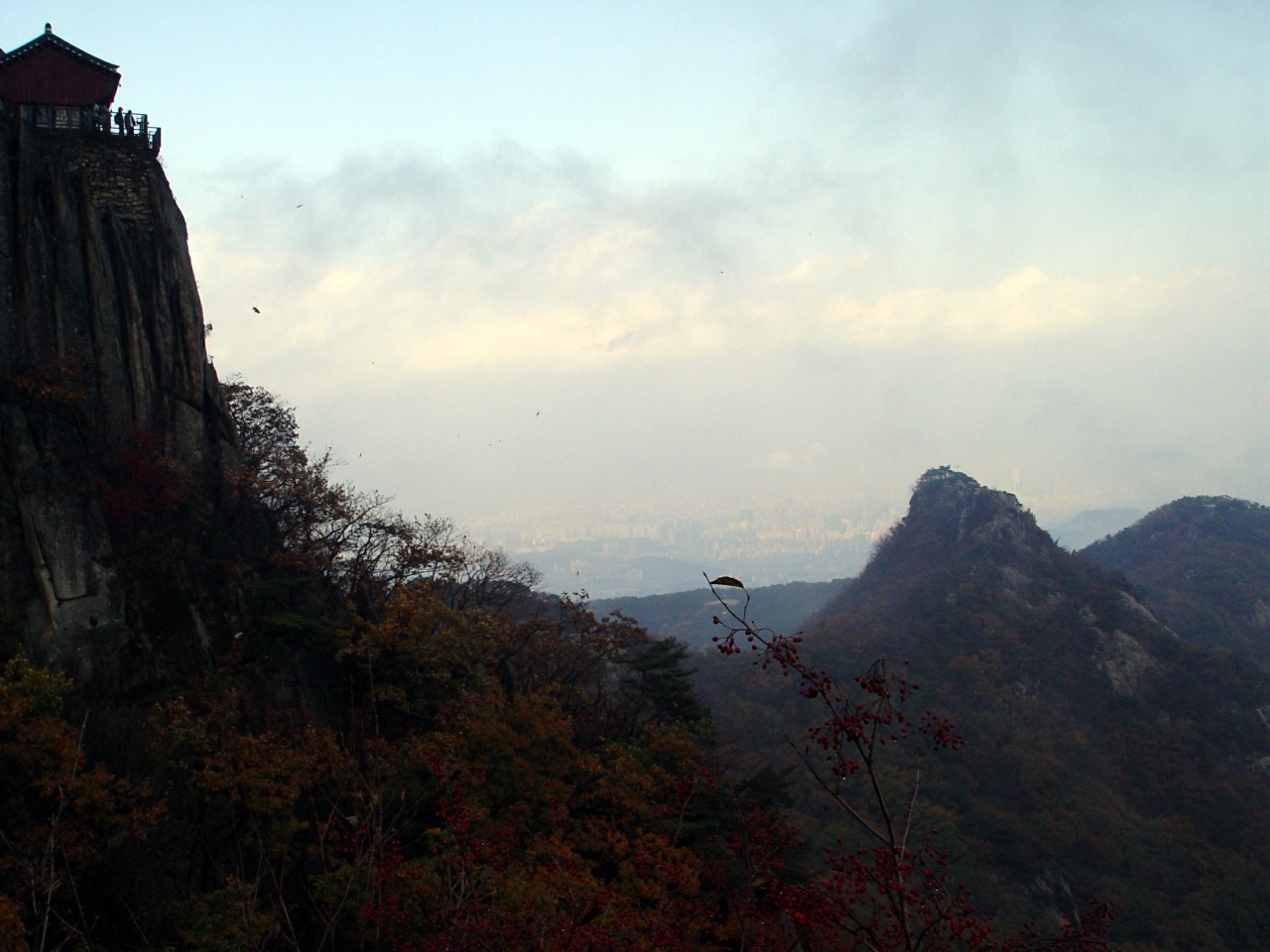
A rocky ridge meeting the city
Gwanaksan straddles Gwanak-gu and Geumcheon-gu in Seoul and Gwacheon and Anyang in Gyeonggi Province, with administrative boundaries cutting across its ridges and slopes. The rocky ridge radiating from the 632.2 m summit is among the most sharply rising landforms in the metropolitan area south of the Han River. Compared with the low-lying urban terrain around it, Gwanaksan's granite ridge ascends steeply from the surrounding flatlands.
Yeonjudae and Yeonjuam
Yeonjudae is a place where one can view both the rocky terrain of Gwanaksan's ridge and the hermitage that sits upon it. Yeonjuam, built on the rock, is an example of mountain Buddhist architecture adapted to rugged terrain, and from Yeonjudae one can look out over the topography of the surrounding ridges and slopes. Various traditions exist regarding the founding and reconstruction dates of Yeonjuam, but it is more appropriate to understand these within the context of oral tradition rather than treating them as established historical fact.
A mountain that crosses administrative boundaries
Gwanaksan does not fall neatly within a single administrative district. Seoul Metropolitan City and Gyeonggi Province, together with four basic local governments beneath them, divide jurisdiction over a single mountain. This administrative division has no effect on the mountain's topography itself, but it means that the approaches and routes to the mountain are diversified across different administrative districts. The Seoul-facing slopes on the Gwanak-gu and Geumcheon-gu side and the Gyeonggi-facing slopes on the Gwacheon and Anyang side each display distinct topographic characteristics.