
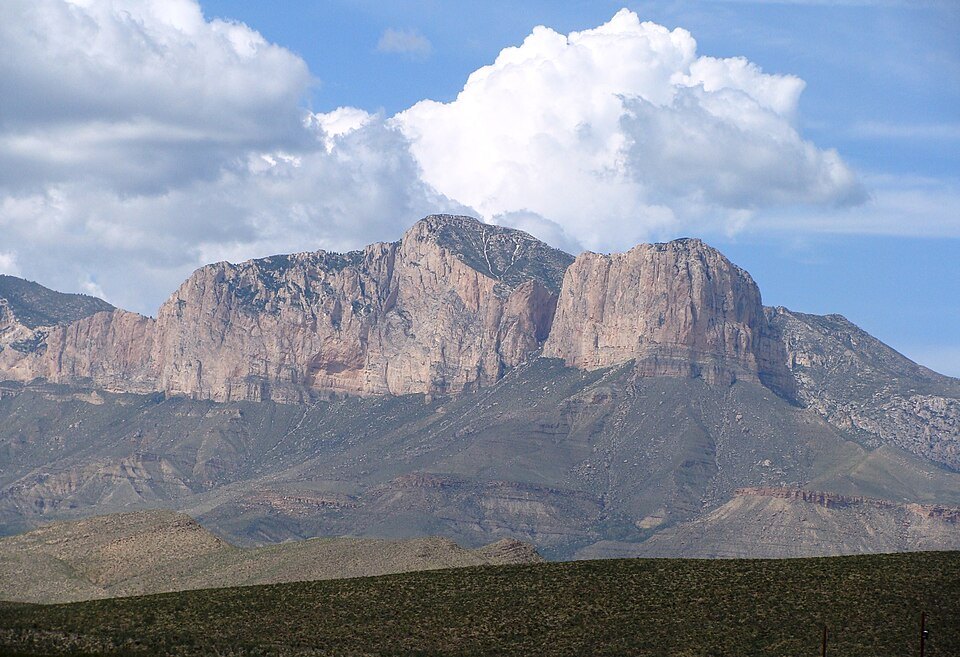
Position and Setting
Guadalupe Peak sits approximately 90 miles (140 km) east of El Paso and about 50 miles (80 km) southwest of Carlsbad, New Mexico. The Guadalupe Mountains range straddles the state line between southeastern New Mexico and West Texas, and the peak's position within that range places it at the highest point of a massif that rises abruptly from the flat, arid terrain of the Chihuahuan Desert. That desert floor context amplifies the mountain's visual and physical prominence: the ascent of more than 3,000 feet (910 m) from base to summit is among the more pronounced relief gains associated with any state highpoint in the contiguous United States.
The Summit Pyramid and Its History
A stainless steel pyramid marks the summit of Guadalupe Peak. American Airlines erected the structure in 1958 to commemorate the 100th anniversary of the Butterfield Overland Mail, a stagecoach route that passed south of the mountain. The pyramid's three faces carry distinct tributes: one bears the American Airlines logo; a second displays a U.S. Postal Service tribute to the Pony Express Riders of the Butterfield Stage; and the third displays a compass. The monument ties the summit physically to the broader history of overland mail and transport across this region of the Southwest, a history that predates the national park designation by roughly a century.
The Butterfield Overland Mail connection gives Guadalupe Peak a layered significance beyond its geological status as Texas's high point. The stagecoach route it commemorates was a major 19th-century communications and transport corridor, and the choice of the summit — visible from considerable distance across the desert — as the site of the centenary marker reflects both the peak's landmark quality and the symbolic resonance of elevation in a largely flat landscape.
Mountain Character and Recorded Events
The peak's desert environment is not merely a scenic backdrop; it shapes the mountain's physical character in meaningful ways. The Chihuahuan Desert context means that altitude gain is accompanied by rapid transitions in temperature and exposure. On New Year's Eve 2022, a hiker was found dead on the mountain; recorded conditions at the time included wind gusts of more than 50 miles (80 km) per hour and wind chills described as well below freezing — a reminder that the desert elevation and the mountain's exposed ridge terrain can produce severe weather conditions despite the region's generally arid reputation.