
Location and Topography
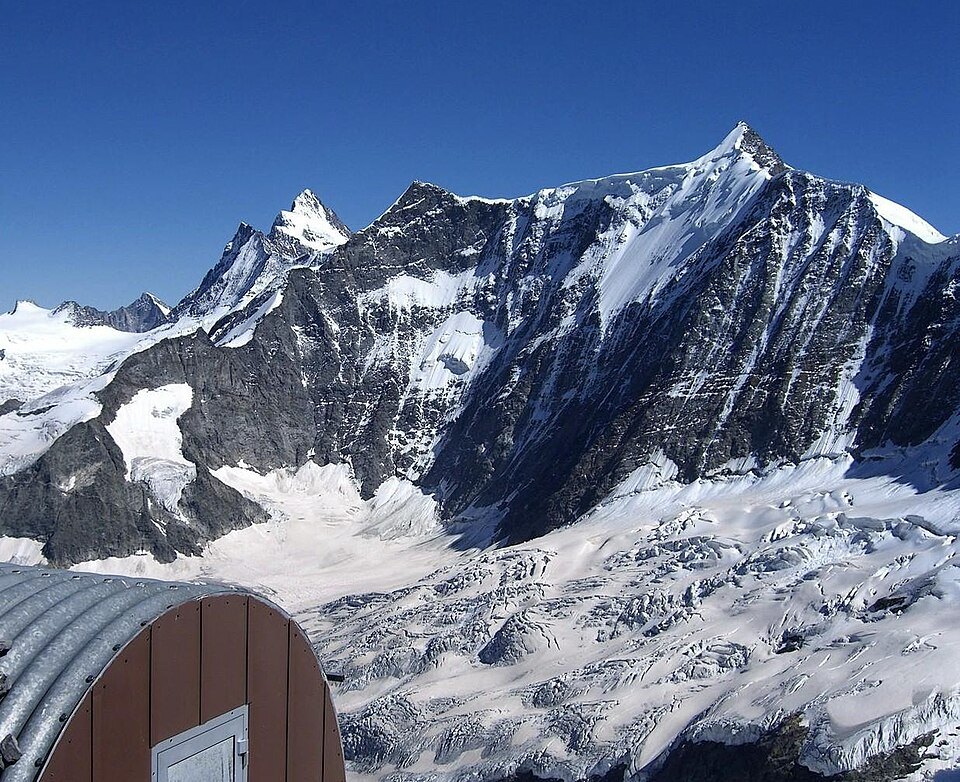
The mountain lies on the main crest of the Bernese Alps, which carries both the watershed between the Aare and the Rhône and the municipal boundary between Grindelwald to the north and Fieschertal to the south. At roughly eight kilometres, Grindelwald is considerably closer to the summit than Fieschertal. Even so, the Gross Fiescherhorn is set slightly back behind the valley of the Lower Grindelwald Glacier and is partly obscured by projecting rock spurs lying in front of it.
The Fiescherhörner form a distinct mountain group that must not be confused with the Valaisian Fiescherhörner. The main summit of the latter group is the Gross Wannenhorn (3,906 m); it lies only a few kilometres further south, also within the Bernese Alps. The Fiescherhörner in the strict sense include, besides the Gross Fiescherhorn, the Hinteres Fiescherhorn (4,025 m) and the Kleines Fiescherhorn (3,895 m), also known by the alternative name Ochs.
The Fiescherwand
The north side of the mountain presents one of the most impressive wall structures in the Bernese Alps: the Fiescherwand, roughly 1,250 metres high and about four kilometres wide. These dimensions give the Gross Fiescherhorn a visual presence that extends far beyond its absolute altitude. The face drops steeply towards the Grindelwald area to the north and defines the landscape from a great distance.
Name History and Nomenclature
In older literature the summit is referred to as "Gross Fiescherhorn"; the form in common use today is "Grosses Fiescherhorn." This variant appears in more recent German-language specialist literature and in official cartographic works. Both spellings refer to the same summit and are occasionally found side by side.
The qualifying element "Fiescher" derives from the Fieschertal on the Valaisian side and links the entire summit group to the glacier and valley system of the same name. The Gross Fiescherhorn's position on the main crest of the Bernese Alps, together with the cantonal-boundary function of two of its ridges, makes it a point of significance both administratively and topographically.
Standing in the Bernese Alps
At 4,049 m above sea level, the Gross Fiescherhorn is counted among the recognised four-thousanders of the Alps according to the UIAA list of 4,000-metre summits of the Alps. By virtue of its exceptional height, its comparatively convenient accessibility from the Grindelwald area, and its central position on the main crest, the mountain occupies a prominent place within the Bernese Alps.