
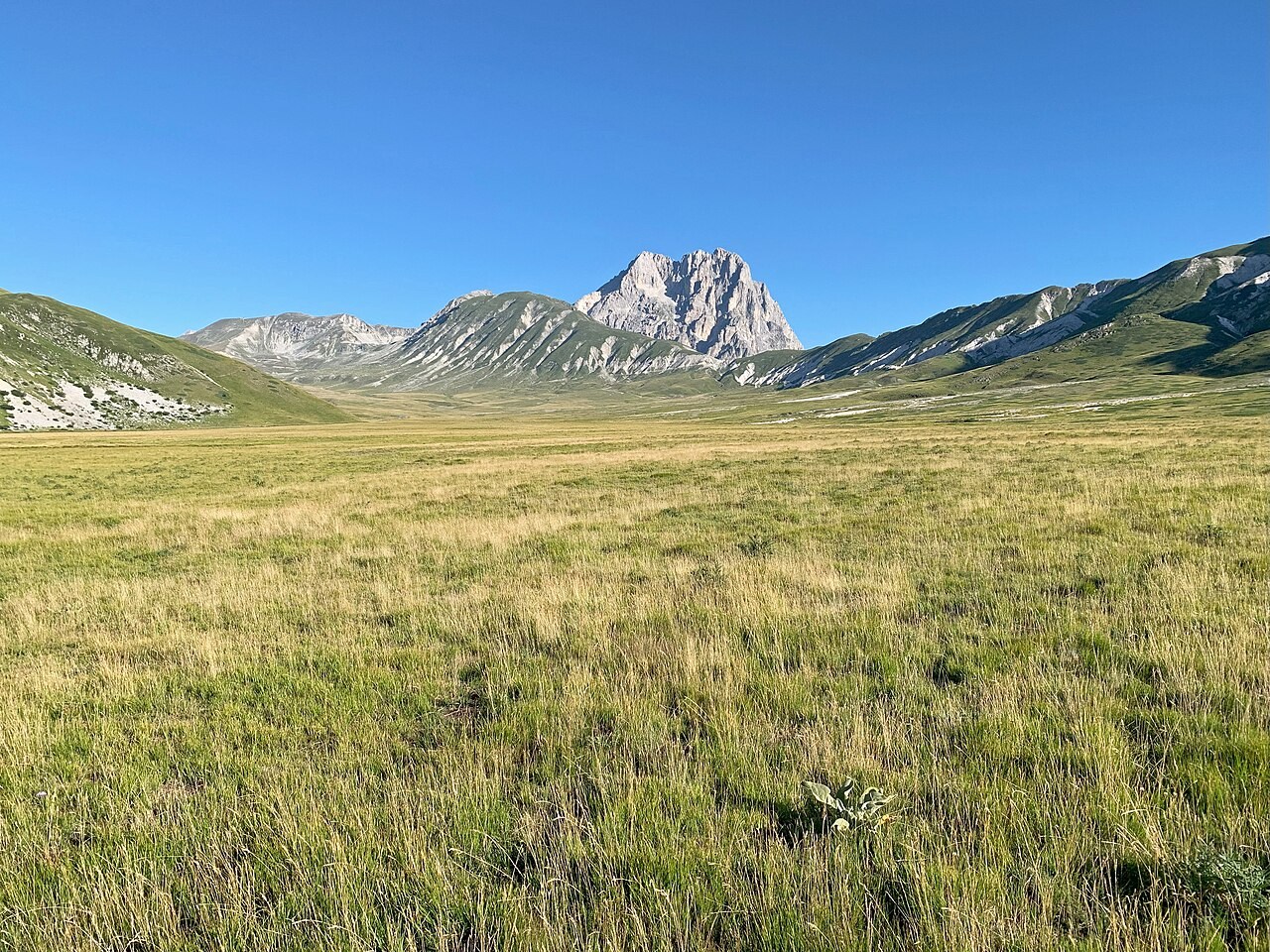
Structure and morphology of the massif
The Gran Sasso d'Italia is built of carbonate rocks, which give the massif its rugged, articulated profile — walls, ridges, and cirques carved into Apennine limestones and dolomites. The massif as a whole and the individual summit of Corno Grande are distinct geographical entities: the former encompasses a broad system of ridges, while the latter is its highest western point at 2,912 m. This distinction is essential for reading the topography of the group correctly and understanding its relationship with the surrounding valleys, including that of Assergi on the northern flank.
The first documented ascent of Corno Grande
In August 1573, Francesco De Marchi set out from Assergi together with his guide Francesco Di Domenico and other companions, undertaking what his account describes as the first documented ascent of the western summit of Corno Grande. The precise date remains uncertain — sources agree on the month and year but not the day — while De Marchi's narrative remains the oldest document to attest explicitly to reaching the summit. This achievement places the Gran Sasso among the Italian massifs with a mountaineering tradition dating to the late Renaissance, anticipating the systematic exploration of the Alps by centuries.
The Calderone and the glacial heritage
Within the cirque of Corno Grande lies the Calderone, a glacial remnant sheltered in a hollow that the massif's carbonate rocks help to define. The glacier is described as a relic — a body of ice bearing witness to past climatic conditions — though on the basis of the available sources alone it is not possible to make claims about its current standing among Apennine glaciers or to state its dimensions with precision. The presence of this glacial body in a limestone-dolomitic setting is one of the most distinctive features of the Gran Sasso's natural landscape, where carbonate geology and glacial morphology meet at unusually high Apennine altitudes.