
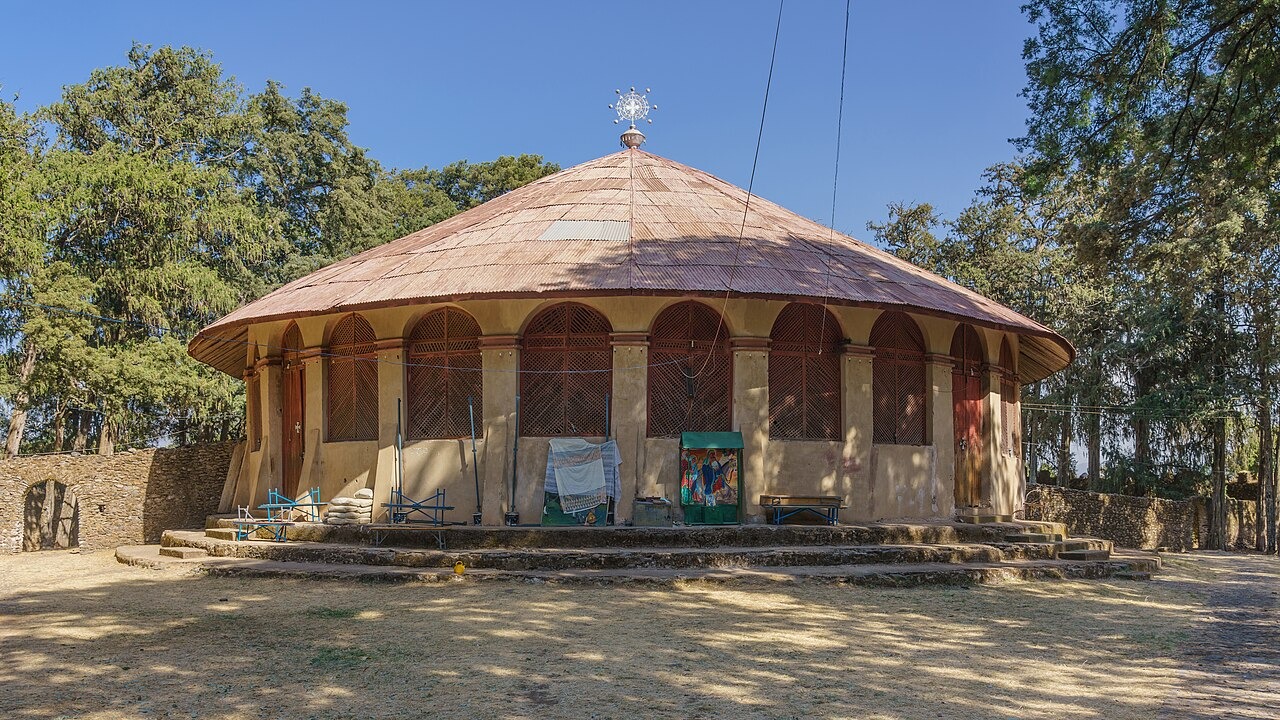
Fasil Ghebbi: The Royal Enclosure and Its 1636 Foundation
Emperor Fasilides chose the Gondar basin for his permanent capital in 1636, raising the first palace within what became Fasil Ghebbi, the royal enclosure. Successive emperors added further palaces, a banqueting hall, and ceremonial baths within the same walled compound. UNESCO inscribed Fasil Ghebbi as a serial World Heritage property in 1979, recognising the ensemble as an exceptional record of seventeenth- and eighteenth-century Ethiopian court architecture.
Qusquam Hills and the Mentewab Palace Complex to the Northwest
Northwest of the city centre, the Qusquam hills carry a distinct palace and church complex associated with Empress Mentewab, who built there in the mid-eighteenth century. The Qaha River runs northwest of the city in the same general corridor. The World Monuments Fund included the Mentewab–Qwesqwam Palace on its 1998 Watch list and has since supported field conservation work at the site. The church retains active Orthodox religious significance for the local community.
Highland Setting and the Society of Architectural Historians' Cultural Landscape Framework
Scholars affiliated with the Society of Architectural Historians have examined Gondar alongside Lalibela as complementary expressions of Ethiopian urban and pilgrimage culture, situating both cities within a broader highland landscape shaped by royal patronage and ecclesiastical tradition. The Gondar basin's elevation moderates the climate of this part of the Amhara Region, and the interplay of palace compounds, churches, and surrounding hills defines the character that the UNESCO serial designation was designed to protect.