
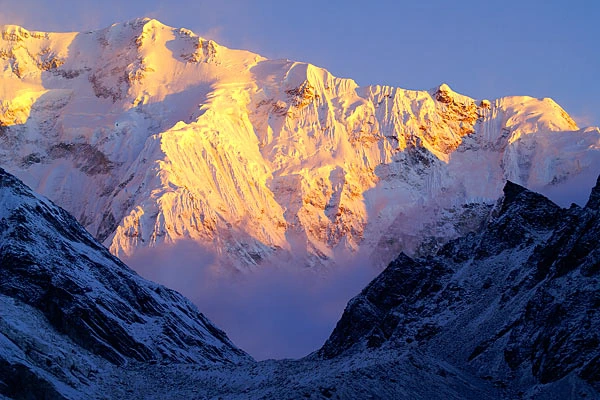
The ridge and its passes
Expedition records in the Himalayan Journal give the lower Goecha La saddle an elevation of approximately 4,940 m. A 2024 Sikkim Gazette forest-boundary description records a nearby point at 4,955 m. Copernicus terrain data show a difference of about 16 m between the forestry trail endpoint on the western shoulder of the crossing and the lower saddle a few dozen metres away.
The higher col near Pandim stands at around 5,100 m according to Anindya Mukherjee's 2011 expedition account. Goecha Peak rises to 6,127 m as recorded on Günter Seyfferth's field map. A 2018 Airports Authority of India trekking itinerary marked a separate viewpoint lower on the approach at 15,100 feet, approximately 4,600 m.
Routes into the Talung basin
John Claude White recorded crossing the Guicha La in 1890 and descending into the Talung drainage toward Sakyong, as documented by Mukherjee in the Alpine Journal. In May 1936, H. W. Tilman and four Sherpas, Pasang Kikule, Pasang Phuta, Nuri, and Tilly, crossed the lower col and the Talung Glacier while investigating a route toward Zemu Gap, with Tilman's report in the Himalayan Journal noting a cairn at the col.
In April 2008 a British party with Karma and Chering crossed from the Yuksom side, camping above the Talung Glacier at Yongiotak while seeking a route to Green Lake via Zemu Gap, as reported in Himalayan Journal vol. 65. In 2011 Anindya Mukherjee and Thendup Sherpa's party crossed the higher saddle near Pandim before descending toward Zemathang, a distinct route from the lower col crossings of 1936 and 2008.
Flora and the Park's Cultural Landscape
Akiyama and Ohba's 2007 paper lists a specimen of cushion-forming Saxifraga jacquemontiana collected by D. G. Long and colleagues near the pass at about 4,870 m on 22 July 1992. In a 2025 study of 20 ethnomedicinal plants, Lahiri and Dash compared three forest patches in the broader Dzongri–Goecha La corridor between 3,500 and 4,500 m and found the greatest diversity at the least disturbed site.
In 2016 UNESCO inscribed Khangchendzonga National Park as a mixed World Heritage property. UNESCO's account links the park's mountains, lakes, rivers, and caves to Indigenous Sikkimese and Buddhist traditions.