
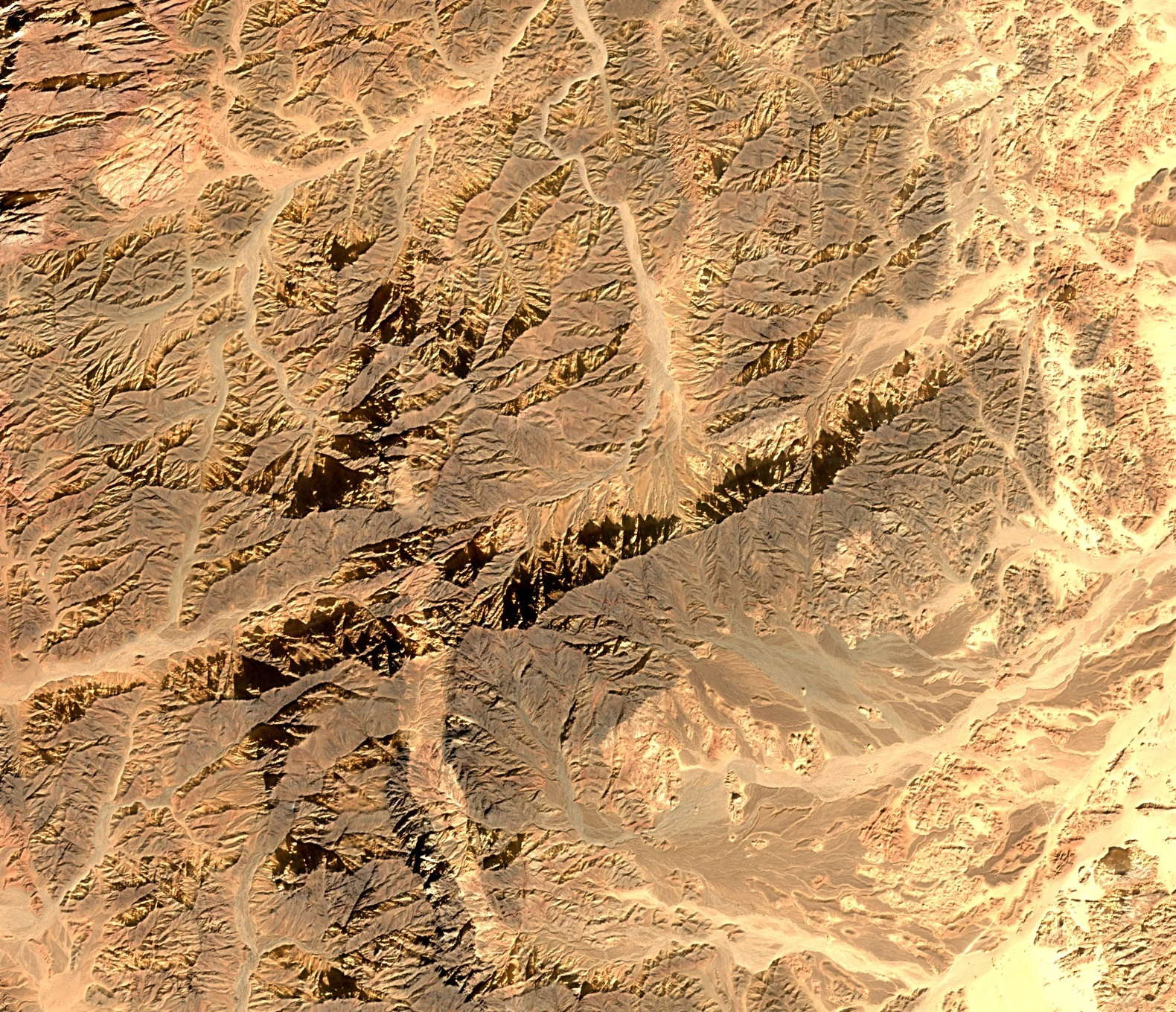
The Stone from the Mountain
Imperial Porphyry is an altered volcanic rock. White to pink feldspar crystals stand out against the darker rock around them. Makovicky and colleagues found that the alteration produced manganese-bearing minerals and fine particles of hematite, both of which help explain the colour. Their samples ranged from dark grey to red, and these mineral signatures can help trace worked stone to its source.
The red stone was used in Trajan’s Forum in Rome and for columns in Diocletian’s mausoleum in what is now Split, Croatia. Two areas of the quarry complex also yielded granite.
Roman Quarrying at Mons Porphyrites
The earliest Roman activity listed in the 4CARE record is a dedication to the god Pan by Apollonius Longinus, dated to 29 CE. The intensive quarrying recorded by archaeologists lasted from the first century into the late fourth or early fifth.
A survey cited by 4CARE describes a dry-stone haulway built to move porphyry. It is around 1.4 kilometres long and associated with a rise of about 600 metres.
Road, Water, and the Fort at Berkou
Fortified stations and wells supplied the desert road from ancient Kaine, now Qena, to the quarries. In 2020 archaeologists excavated a fort from the Flavian period at a point along this road. Inscribed pottery sherds found inside gave them the fort’s name, Berkou. The builders reused parts of an earlier settlement’s water system, a detail that shows how the Roman outpost drew on infrastructure already present in the valley.