
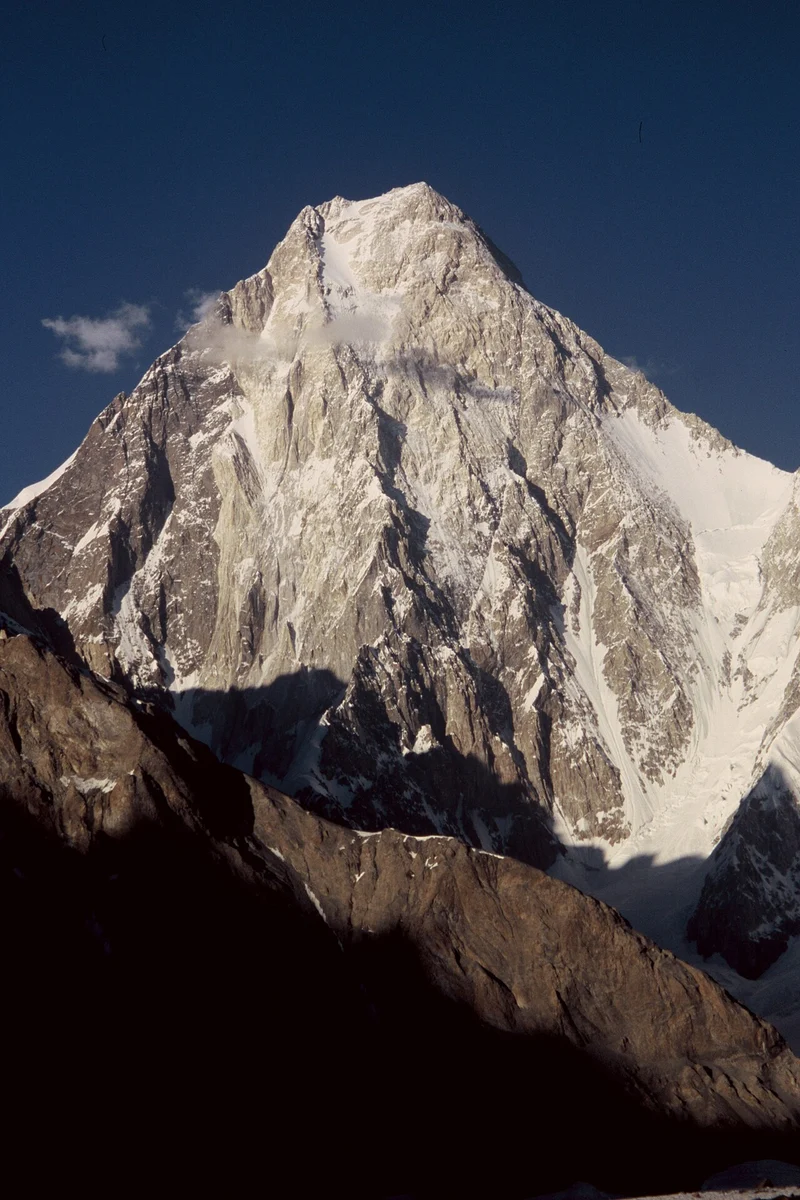
The 1958 First Ascent via the Northeast Ridge
The first team to reach the highest summit of Gasherbrum IV was the Italian expedition of 1958, led by Riccardo Cassin. Walter Bonatti and Carlo Mauri, supported by other expedition members, made the decisive push and stood on the highest point on 6 August 1958, having ascended by the northeast ridge. Expedition notes recorded in the Himalayan Journal describe a prominent feature called the Black Tower encountered on the route, and document the climbers first reaching the northern summit before making a traverse to the higher summit — a sequence that speaks to the peak's complex upper topography and the route-finding demands it placed on the first ascent party.
The first ascent in 1958 required a traverse between the north summit and the higher south summit, with the nature of the ground above the Black Tower adding to the technical commitment the route demanded.
The Shining Wall — West Face, 1985
Nearly three decades after the first ascent, Gasherbrum IV became the stage for one of the most discussed climbs in the history of alpinism. In July 1985, Polish climber Wojciech Kurtyka and Austrian Robert Schauer completed a route up the peak's west face — a wall of approximately 2,500 m known as the Shining Wall — in full alpine style, without fixed ropes or high-altitude support camps. Kurtyka described the team as reaching the top of the wall at approximately 7,900 m before they began their descent. They did not reach the highest summit of Gasherbrum IV, and the available record does not confirm whether the north summit was attained during their descent or upper traverse.
The west face, approximately 2,500 m in height, was climbed alpine style in 1985. After reaching the top, the climbers descended by the northwest ridge. Kurtyka's account in the American Alpine Journal is the primary document of the climb.
The Northwest Ridge, 1986
The year following the Shining Wall ascent, a different line on Gasherbrum IV received a first complete ascent. In June 1986, Greg Child, Thomas Hargis, and Tim Macartney-Snape established a route via the northwest ridge, with Child reporting in the American Alpine Journal that the team reached the summit. The northwest ridge offered a distinct character from both the northeast ridge of the first ascent and the severe west face, adding a third established line to the peak's climbing record within the space of a single decade.
The 1985 ascent of the west face and the 1986 ascent represented a period of concentrated activity on Gasherbrum IV. Gasherbrum I and II are eight-thousanders with established trade routes, while Gasherbrum IV, at 7,925 m, has attracted climbers pursuing its technical faces and ridges.
Geography and Setting
Gasherbrum IV sits within the Baltoro Muztagh sub-range of the Karakoram. It shares the Gasherbrum massif with Gasherbrum I, II, and III, and retains a distinct profile, with the west face presenting a wall of notable scale and angle visible from the Baltoro Glacier approaches. The peak straddles territory administered by Pakistan and China, with principal access historically from the Pakistani side.
The elevation of 7,925 m, as listed by Pakistan's Ministry of Foreign Affairs, is the standard figure for Gasherbrum IV. Its two summits — the north summit and the higher main summit — and the ridge terrain connecting them have shaped the strategic decisions of every expedition that has attempted the peak, from the Cassin team's traverse in 1958 to subsequent climbers approaching by other faces and ridges.