
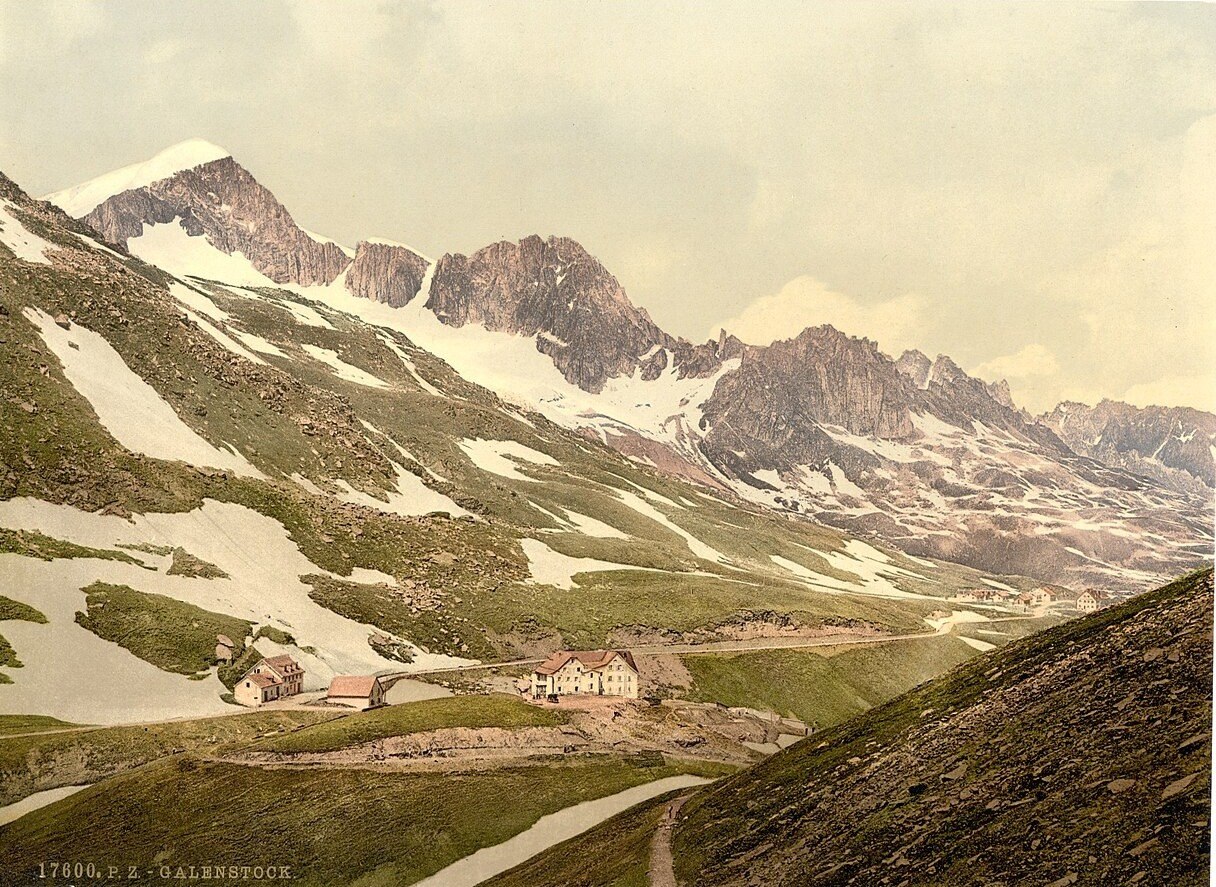
A Summit Shaped by Wind and Ice
Galenstock reaches 3,586 metres in the Urner Alps, positioned close enough to the Furka Pass that the pass itself forms part of the approach context described by the Swiss Alpine Club. The Club notes the presence of cornices along the summit ridges — overhanging accumulations of wind-driven snow that form along the crests above the pass and define the upper character of the mountain. These cornices are a structural feature of the summit zone, produced by the prevailing wind patterns that move across the high terrain between the Rhone and Reuss valleys. The ridge lines that lead toward the highest point follow the edges where these formations develop, giving Galenstock a summit environment shaped as much by wind as by rock.
The First Ascent of 18 August 1845
The Swiss Alpine Club archive records the first ascent of Galenstock on 18 August 1845, a date precise enough to anchor the event within the broader history of Urner Alps exploration. The two guides on that ascent were Hans Währen and Melchior Bannholzer. During the descent, a cornice broke beneath Dollfus junior, carrying him down the slope until he came to rest against a protruding rock. Währen and Bannholzer reached him and recovered him from the position where the rock had arrested his fall. The incident is recorded in the archive without elaboration of injuries or further consequences, but its inclusion in the historical account underlines the conditions that the first-ascent party encountered on the corniced ridges described by the Club.
Guides to the Neuchâtel Glaciologists
Beyond the 1845 ascent, the Swiss Alpine Club archive documents another dimension of Währen and Bannholzer's work: their role as guides for Neuchâtel glacier researchers operating in the region. The archive connects these two men to the scientific expeditions that were beginning to systematically study the Urner Alps glaciers during the mid-nineteenth century, a period when the relationship between local mountain guides and visiting naturalists was central to how Alpine science was conducted. The archive does not detail specific expeditions or findings beyond this association, but the connection places both guides at the intersection of alpine climbing and early glaciological fieldwork — a combination that was characteristic of the most significant mountain work of the era.