
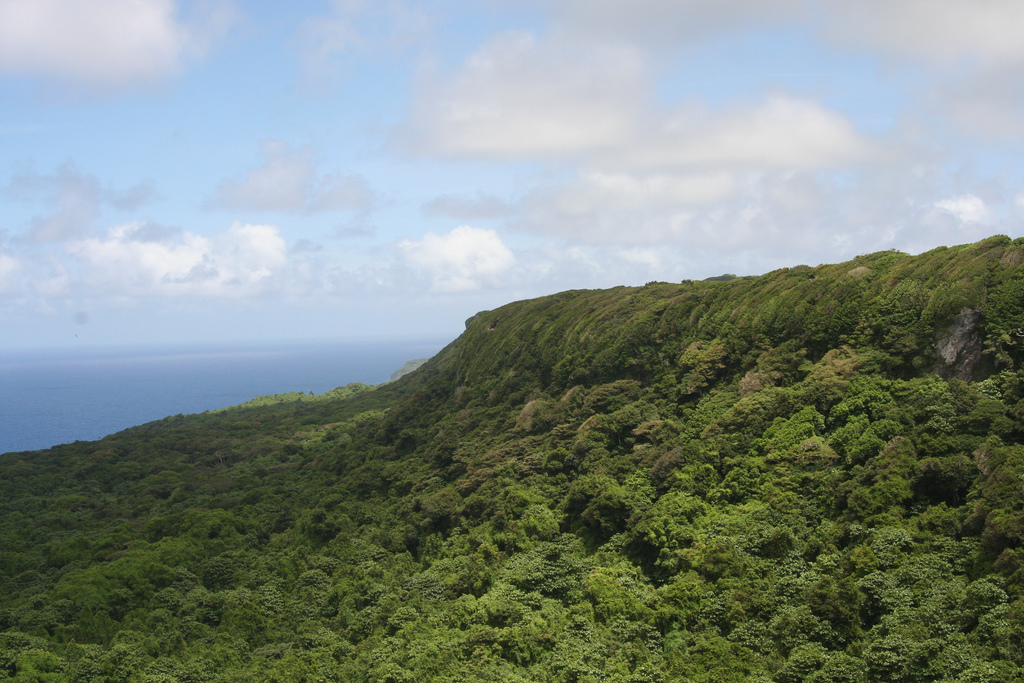
Limestone Terraces and an Ancient Foundation
ʻEua carries some of the oldest igneous rocks in Tonga, overlaid across portions of the island by shallow-marine limestone deposited during the Eocene. Along the eastern ridge, facing the Tonga Trench, that limestone has been sculpted into a staircase of stepped terraces. In his 1932 Bishop Museum survey, J. Edward Hoffmeister mapped six distinct levels along this exposure; the subsequent U.S. Geological Survey synthesis interpreted those steps as records of successive uplift events and episodes of marine erosion, each terrace marking a former shoreline now held high above the sea.
A Wartime Fossil Find on the 400-Foot Terrace
In 1943, U.S. geologist Harold T. Stearns visited ʻEua while working as a consultant to the armed forces at Pacific bases. On an eastern terrace roughly 120 metres above sea level, he collected about half a dozen fossil brachiopods. These marine animals have two shells. Such fossils preserve a record of marine life in rock that is now well above the sea.
Forest Plots, Elevation, and a National Park
Between June and July 1990, botanists laid out 40 forest plots across ʻEua and recorded species composition at each site. The 1996 paper published in the New Zealand Journal of Botany reported that the sampling distinguished two coastal forest types and four inland types, and that species counts in the plots rose with elevation. The preliminary findings were submitted to the Tongan government; the authors report that the data contributed to the establishment of ʻEua National Park in 1992, four years before the study reached print.