
Landforms and Drainage
Valeriy Shesternin's 2017 route description places the summit where the Novy and Frunze spurs meet, with Frunze Glacier descending the north slope from that point. Nauruksai and Ulken Mynzhilki feed the Left Talgar in the surrounding drainage. Meltwater from Shokalsky Glacier runs toward the Middle Talgar.
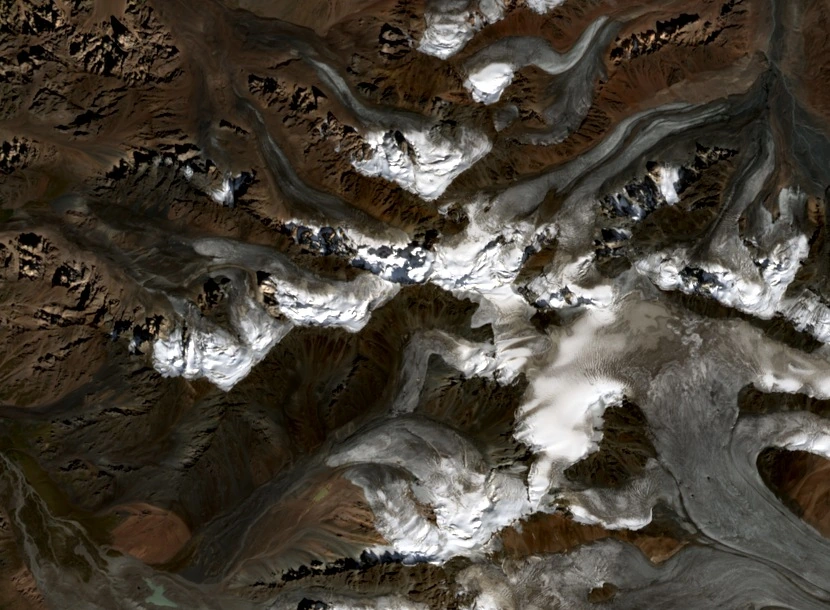
A Sentinel-2 true-colour image acquired on 29 August 2025 shows high rock, snow patches, and glacier forms in the immediate vicinity of Frunze Peak. The image captures the ridge connecting the summit area to Stalsky Pass to the northeast, with alternating exposures of rock, snow, and ice visible along that line.
Archival Route Records
The Kazakhstan climbing catalogue records two east-ridge routes, one linked to the Severtsov Glacier and one to the Shokalsky Glacier. It credits M. Grudzinsky and 1947 for the route connected with the Severtsov Glacier. A 1978 expedition report's labelled sketch also shows Frunze Peak as a named summit in the range.
The Saint Petersburg Mountaineering Federation catalogue also records both east-ridge routes with their different glacial approaches. The 2025 Kazakhstan official inventory gives Frunze Peak its own entry at 4,450 metres, distinct from the two surrounding passes.
Abaev's 2015 Traverse
In his 2015 report, Aleksandr Abaev described following Frunze stream out of the Left Talgar valley to reach Frunze Glacier. His party crossed the summit on 11 August 2015 in low cloud with snow pellets falling and then continued toward Stalsky Pass. Abaev recorded the summit height as 4,430 m in that account.
Shesternin's 2017 Crossing
On 26 August 2017, Valeriy Shesternin's party traversed from Stalsky Pass over Frunze Peak and then descended toward Frunze Pass and the Severtsov Glacier. The route table in that expedition report gives the peak at 4,450 m while the field section gives 4,420 m, with both figures drawn from the same report.
Shesternin's account describes the ridge surface on the approach from Stalsky Pass as alternating rock, snow, and ice. The descent toward the Severtsov Glacier passed through ice and scree, as the 2017 field notes record.