
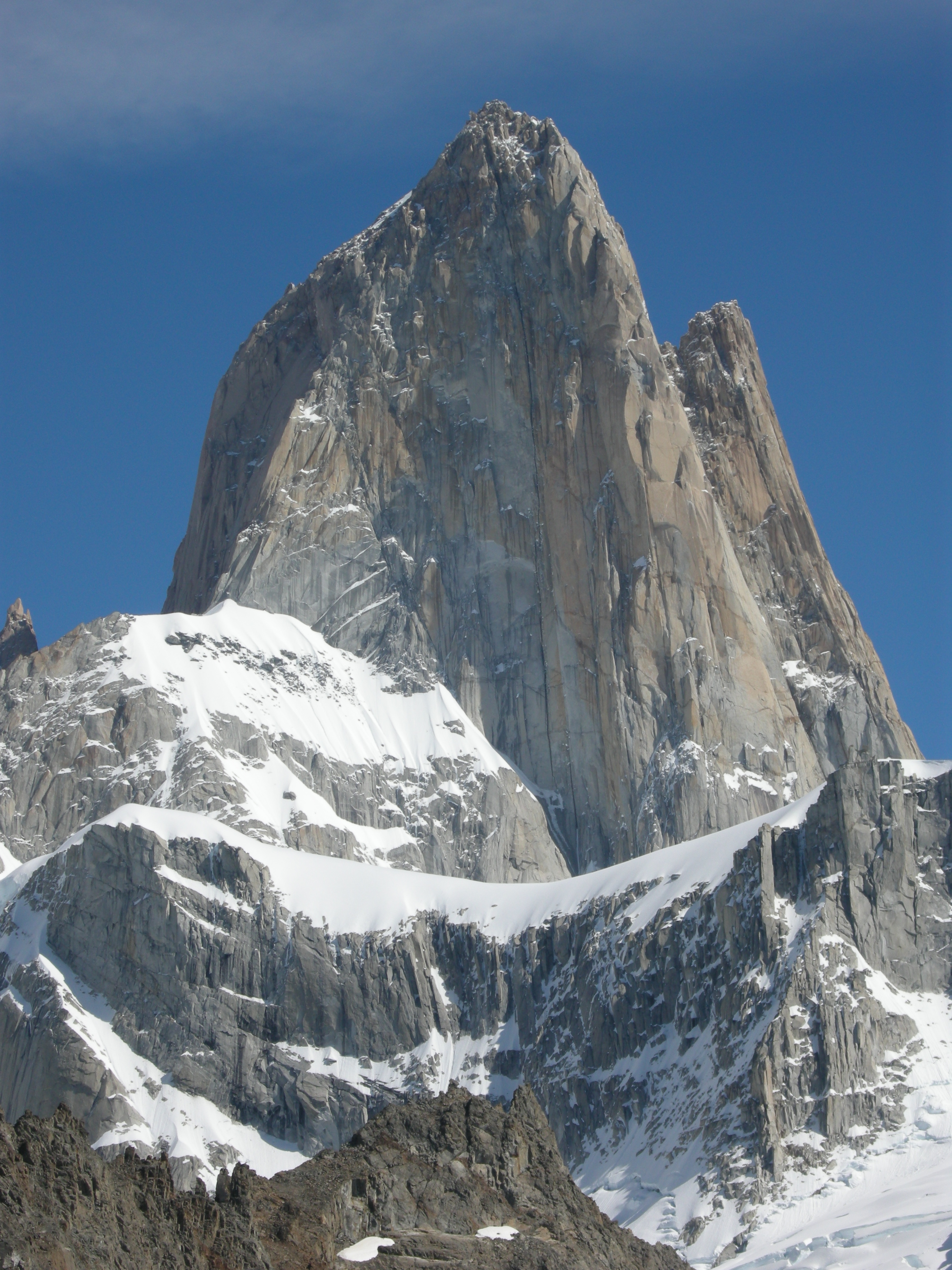
The rock of the wall
The rock of the massif formed from magmas that cooled at depth during the Miocene. In 2012, Ramírez de Arellano and colleagues dated zircons from several intrusions of the Chaltén complex and obtained ages of between 16.9 and 16.4 million years. Within the Fitz Roy group they described granodiorite and minor granite bands. On the East Pillar, Rolando Garibotti describes a fine-grained golden granite.
The East Pillar
In 1974 a Swiss rope team led by Toni Holdener and Hans Peter Kasper made progress on the East Pillar — the buttress defining the left margin of the face — but bad weather forced them to retreat roughly 200 metres below the summit. Casimiro Ferrari and Vittorio Meles, of the Ragni di Lecco, completed that same line in 1976 after six days on the wall; a lower section of the route was equipped with fixed ropes and etriers, gear that climbers partially removed in 2014 and 2015.
The route is 1,200 metres long. In 2016 David Bacci and Matteo Della Bordella repeated it, freeing many pitches, though they resorted to aid on nine of them. Between 6 and 8 March 2026, Tasio Martín and Seán Villanueva O'Driscoll completed the first all-free ascent of the route; Garibotti's account details snowy sections, cracks the team had to clean before making progress, and a crux pitch following a crack leftwards. Free climbing means progressing using only natural features, with gear serving exclusively as protection.
El Corazón and the 2011 link-up
During the 1991–1992 season, Kaspar Ochsner and Michel Pitelka identified, roughly 850 metres up the wall, a heart-shaped scar left by a rockfall; Ochsner described the feature in his account published in the American Alpine Journal in 1993. The rope team reached the summit on 20 February 1992.
In 2011 Nicolas Favresse and Seán Villanueva O'Driscoll made an on-sight free ascent of the east face, linking pitches from the Ferrari route, El Corazón, and Royal Flush. From camp to return, the ascent took them 36 hours.