
A region reconstructed from medieval itineraries
In a study published in 2023 in Hespéris-Tamuda, Chloé Capel and Guillaume Chung-To reconstruct twelve itineraries drawn from the ʾUns al-Muhaǧ, known as the Petit Idrīsī, which documents journeys from the 12th century. Five of these itineraries cross what they define as the historical Fāzāz between present-day Taza and Khénifra, though their exact routes cannot be fixed on the ground with certainty.
The authors also trace the siege of the Qalʿat Mahdī, taken by the Almoravids in 1072 according to their chronology. Most hypotheses place the stronghold between Mrirt and Khénifra. Others seek it further east, in the upper valleys of the Sebou or the Moulouya.
The Ajdir causses and the Aguelmam Azegza depression
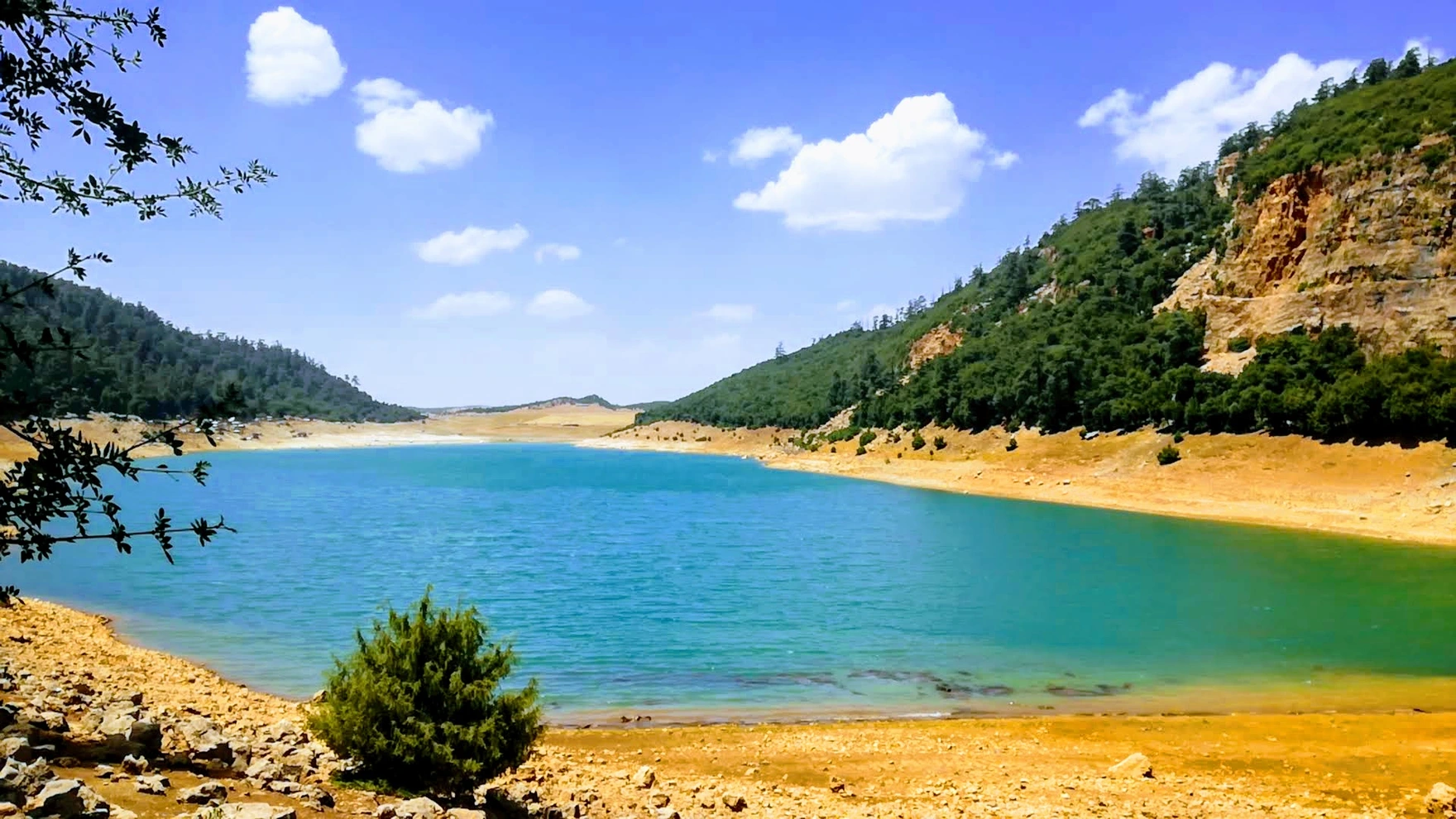
The Ajdir causses illustrate the carbonate structure of the western Middle Atlas: Liassic limestones and dolomites outcrop across broad flat surfaces, cut by fracturing and karstic weathering. In this setting, Lake Aguelmam Azegza — also spelled Azigza — occupies a tectono-karstic depression within the cedar forests east of Khénifra. A thesis defended at Aix-Marseille University in 2019 establishes the hydrological link between the lake and the Ajdir causses.
The study published by Boutsougame and colleagues in 2022 examines how carbonate rocks and climatic variations influence the lake's water supply. In the August 2018 photograph, a pale rock face outcrops above the shoreline, interrupting the forest that covers the slopes.
Ajdir and the recognition of Amazigh culture
On 17 October 2001, at Ajdir, King Mohammed VI signed the dahir establishing the Royal Institute of Amazigh Culture. The Institute holds the speech delivered on that occasion.
Khénifra National Park, created in 2008, protects among other things forest massifs and wetlands of the Middle Atlas. In 2016, UNESCO recognized the Cedar Forest Biosphere Reserve, which covers a wider region.