
Forest zones that change with elevation
Mount Emei lies at the southwestern edge of the Sichuan Basin, in the transitional zone between the basin and the plateau. Complex tectonic uplift and erosion have shaped its gorges and steep slopes. Ascending from lower elevations, evergreen broadleaf forest gives way to mixed needle-and-broadleaf forest, with fir and other conifers appearing at higher altitudes. The ridge trail reaches Wanfo Summit at an elevation of 3,099 meters.
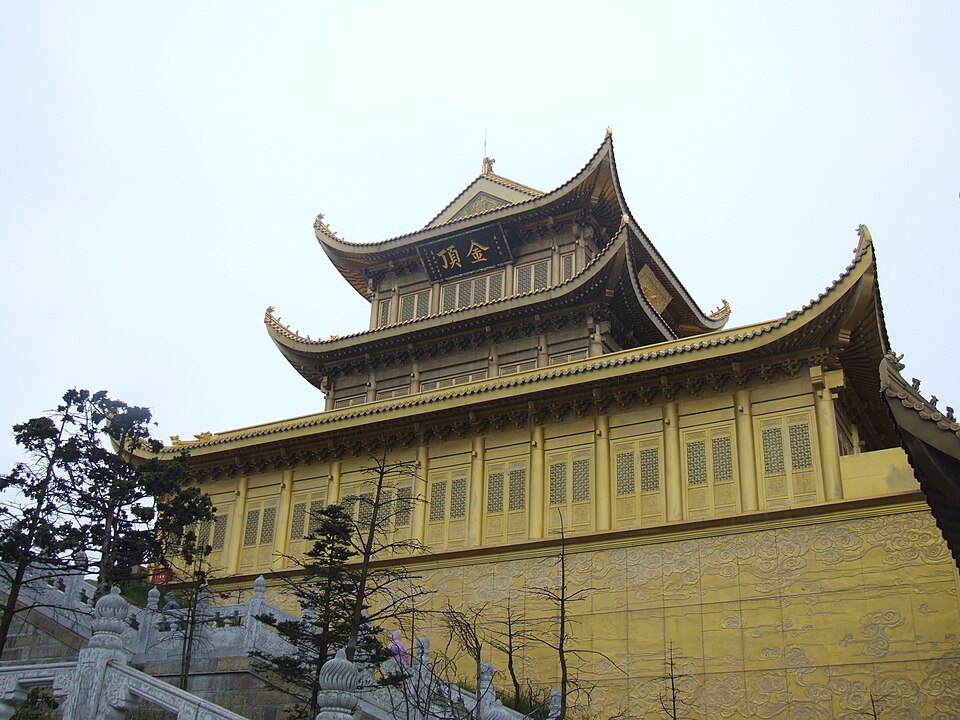
The Golden Summit, Qianfo Summit, and Wanfo Summit are arranged along the high ridge. On maps, the Golden Summit usually appears together with Huazang Temple, while Wanfo Summit is the mountain's highest point. Distinguishing these place names helps in reading pilgrimage routes and prevents the temple site from being mistaken for the geographic high point.
How the Samantabhadra tradition entered the mountain
Mount Emei is one of the Four Sacred Buddhist Mountains of China, renowned for its association with the bodhisattva Samantabhadra. Wannian Temple preserves a tenth-century bronze statue of Samantabhadra; Baoguo Temple at the foot of the mountain and Qingyin Pavilion further up represent temple architecture from different periods. Distributed across the slopes, they make the pilgrimage journey a sequence of walks and acts of veneration.
Continuing up from Wannian Temple, Xixiang Pool and Jieyin Hall are waypoints marked on local cultural tourism planning maps. Reading the map through these nodes helps clarify why the Golden Summit became the focal gathering point for pilgrims, and shows how the high-altitude temples made use of the ridge and slopes when arranging their buildings.
Why the Leshan Giant Buddha was inscribed on the World Heritage List together with Mount Emei
The Mount Emei Scenic Area and the Leshan Giant Buddha Scenic Area were jointly inscribed on the World Heritage List in 1996. Carving of the Buddha began in the eighth century; it stands approximately 71 meters tall, facing the confluence of the Min, Dadu, and Qingyi rivers. The cliff face where it stands and the mountain temples of Mount Emei are separate sites.
The temples of Mount Emei were built to follow the mountain slopes, while the Leshan Giant Buddha was carved directly into a riverside cliff. Viewing the two sites together makes it possible to understand how Buddhist architecture engaged with the radically different landforms of southwestern Sichuan.