
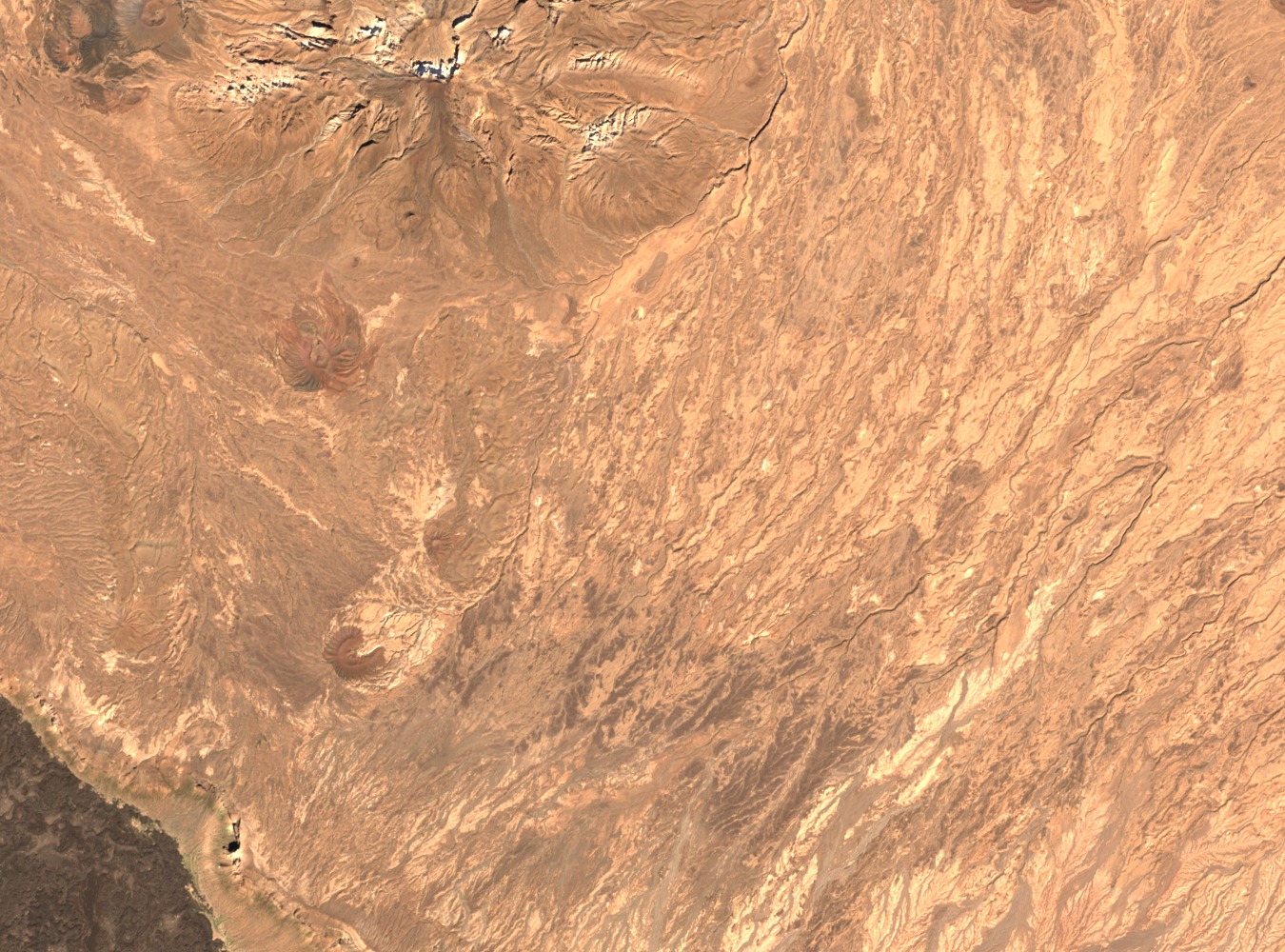
Position Within the Tarso Toussidé Complex
Ehi Timi occupies a distinct position within the Tarso Toussidé volcanic complex. The ASTER-based study by Permenter and Oppenheimer places it in the northern part of the massif, northeast of Pic Toussidé, with plan dimensions of approximately 4.7 by 4.1 kilometres. Its location is distinct from both Ehi Sosso and the nested Yirrigue and Trou au Natron caldera structures, giving it an identifiable profile within the broader massif.
Lava Stratigraphy and Relative Emplacement
Research by Permenter and Oppenheimer, published in the Bulletin of Volcanology and drawing on ASTER satellite analysis, places the lava emplacement at Ehi Timi within the same broad concluding stage of western Tibesti volcanism as Pic Toussidé. This grouping is based on shared characteristics of lava surface character, flow boundaries, and weathering, and reflects relative rather than precisely established chronological equivalence.
Remote Sensing and Structural Observation
ASTER imagery and derived topographic data have allowed researchers to distinguish the surface profiles and lava flow patterns of neighbouring volcanic structures across western Tibesti. Among the concrete observations the study records are comparatively fresh lava ramparts on the flanks of these edifices. This remote-sensing work, central to the Permenter and Oppenheimer study, clarifies how Ehi Timi relates spatially and volcanologically to surrounding edifices, supporting field-scale interpretation of the massif's architectural complexity.