
A Miocene Shield Reduced by the Great Escarpment
Argon-40/argon-39 analysis by Tapu, Ubide and Vasconcelos (2022) dated sampled basaltic to trachytic rocks from Ebor at approximately 20.39 to 19.39 million years ago, placing the volcano in the Cenozoic age-progressive chain of eastern Australia. The shield formed on older folded rocks of the New England Orogen. Ashley, Duncan and Feebrey (1995) reconstructed a structure at least 45 kilometres wide and at least 800 metres above its original rock basement, and estimated that approximately 90 percent of the volcano's volume had been removed by erosional retreat of the Great Escarpment; lava sequences up to nearly 400 metres thick were recorded across surviving remnants.
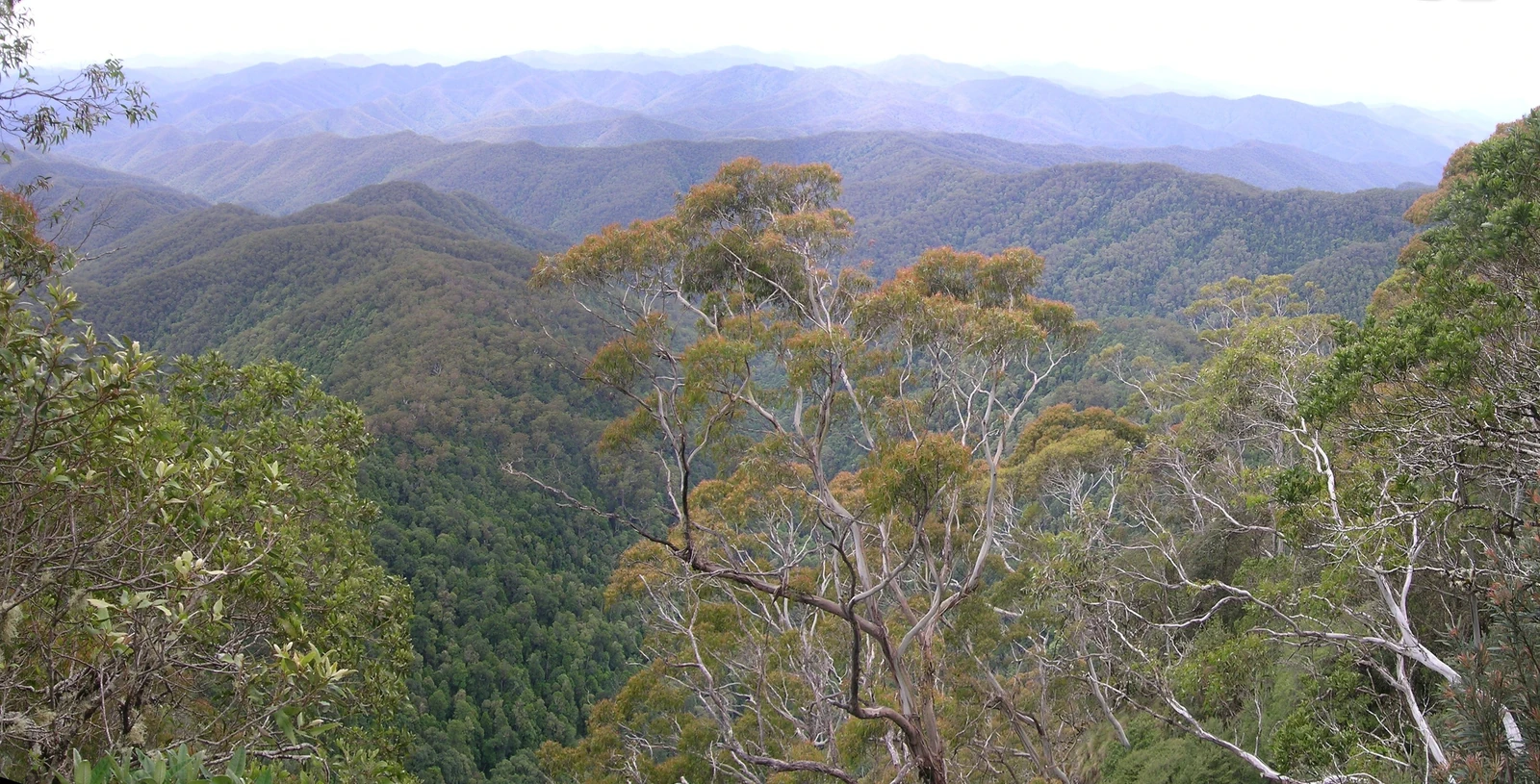
The Australian Government’s 1994 World Heritage nomination dossier describes how the escarpment retreated unevenly: relatively soft Nambucca Beds south of the Bellinger Fault eroded from beneath the basalt cap, while the high escarpment rim persisted to the north and east. The NSW National Parks and Wildlife Service identifies at least five basalt flows composing the 300-metre-plus escarpment at regional scale. No original summit altitude has been established for the eroded shield.
Three Distinct Remnants: Escarpment, Crescent, and Trachyte Outlier
Point Lookout, at 1,563 metres as recorded in the 2021 management plan, sits on the edge of the high basalt escarpment. Farther downslope, The Crescent exposes rock that solidified underground in the former centre of the volcano. These two landforms preserve a readable contrast between the resistant lava cap that armoured the escarpment and the coarser intrusive core exposed after overlying material was removed.
Wrights Lookout preserves a third and distinct element: a remnant of trachyte, chemically and texturally different from the basalt flows of the main escarpment. The 2022 research by Tapu, Ubide and Vasconcelos used mineral chemistry and textures across Ebor, Nandewar, and Canobolas to infer that pulses of fresh magma repeatedly entered the system before eruptions. The radial drainage of the Bellinger headwaters, legible at landscape scale, is an additional structural remnant recognised in the World Heritage nomination dossier.
Country, Conservation Chronology, and World Heritage Recognition
The Thunggutti (Dhanggati), Gumbaynggirr, and Anaiwan peoples are identified in the 2021 management plan as the traditional peoples of the lands now covered by New England National Park, and their continuing relations to Country are acknowledged throughout the plan. The New South Wales government set the area aside for public recreation in 1931 and named it New England National Park in 1933. The park was formally dedicated in 1935 and publicly opened at Point Lookout in 1937. The park was included in the Gondwana Rainforests of Australia World Heritage property in 1986, that property was expanded in 1994, and the area was included on the Australian National Heritage List in 2007.
In its 1994 technical evaluation, the IUCN described how erosion of the basalt helped supply nutrients to soils below the escarpment, where rainforest grows. UNESCO recognises both the ongoing erosion of the old shield volcano and the diversity of rainforest species across the World Heritage property. Cgoodwin’s photograph from Point Lookout shows the forested ridges receding from the basalt escarpment.