
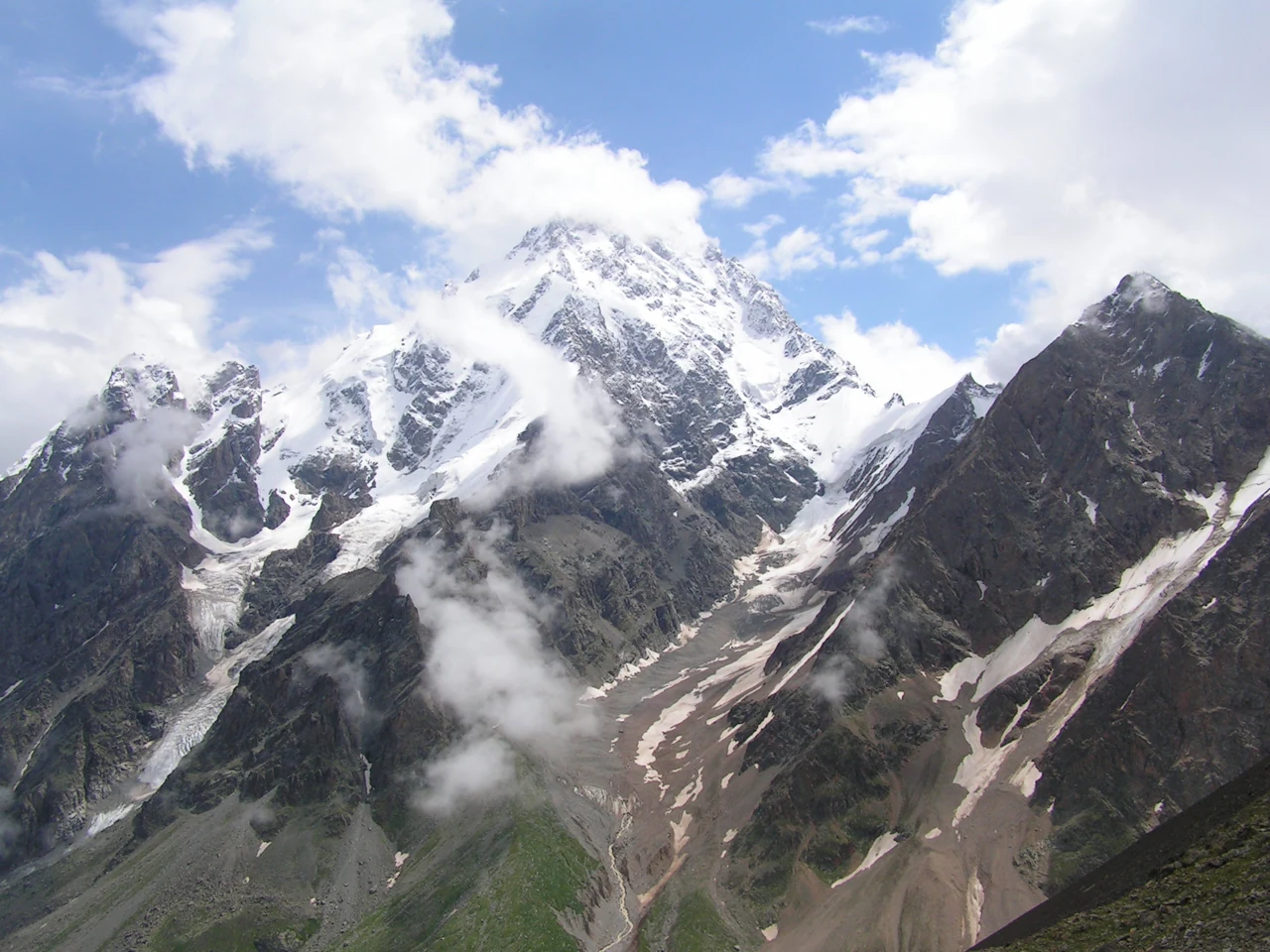
Summit and Massif
The Bezengi sector presents a concentrated arrangement of high summits in the central Caucasus. Bezengi climbing camp identifies the principal peaks and the relief of the northern range, placing the main Dykh-Tau summit alongside a distinct East Summit at 5180 m. Pushkin Peak lies in the direction of the neighboring Koshtantau. The Russian Mountaineering Federation recognizes both Dykh-Tau and Koshtantau as independent objectives within its mountaineering award program, treating their separate summit positions, elevations, and climbing histories as distinct.
The 1888 First Ascent
Albert Frederick Mummery and Heinrich Zurfluh made the first recorded ascent of Dykh-Tau in 1888. Mummery's account, published in My Climbs in the Alps and Caucasus in 1895, provides a firsthand description of the climb and the mountain's steep, ice-covered upper terrain. The American Alpine Journal records that a party led by Cockin completed a second ascent of Dykh-Tau the same year.
Survey Revision and Nomenclature
Russian survey work in the region reassigned the names Dykh-Tau and Koshtantau, which earlier sources had applied in the reversed sense. The Alpine Club formally noted the change in its 1894 proceedings, recording the corrected nomenclature alongside revised elevations. Because Mummery's 1895 book postdates the survey revision, his published account uses Dykh-Tau in its modern sense. Earlier expedition reports written before 1894 may apply the names in the reversed order and should be read with that context in mind.