
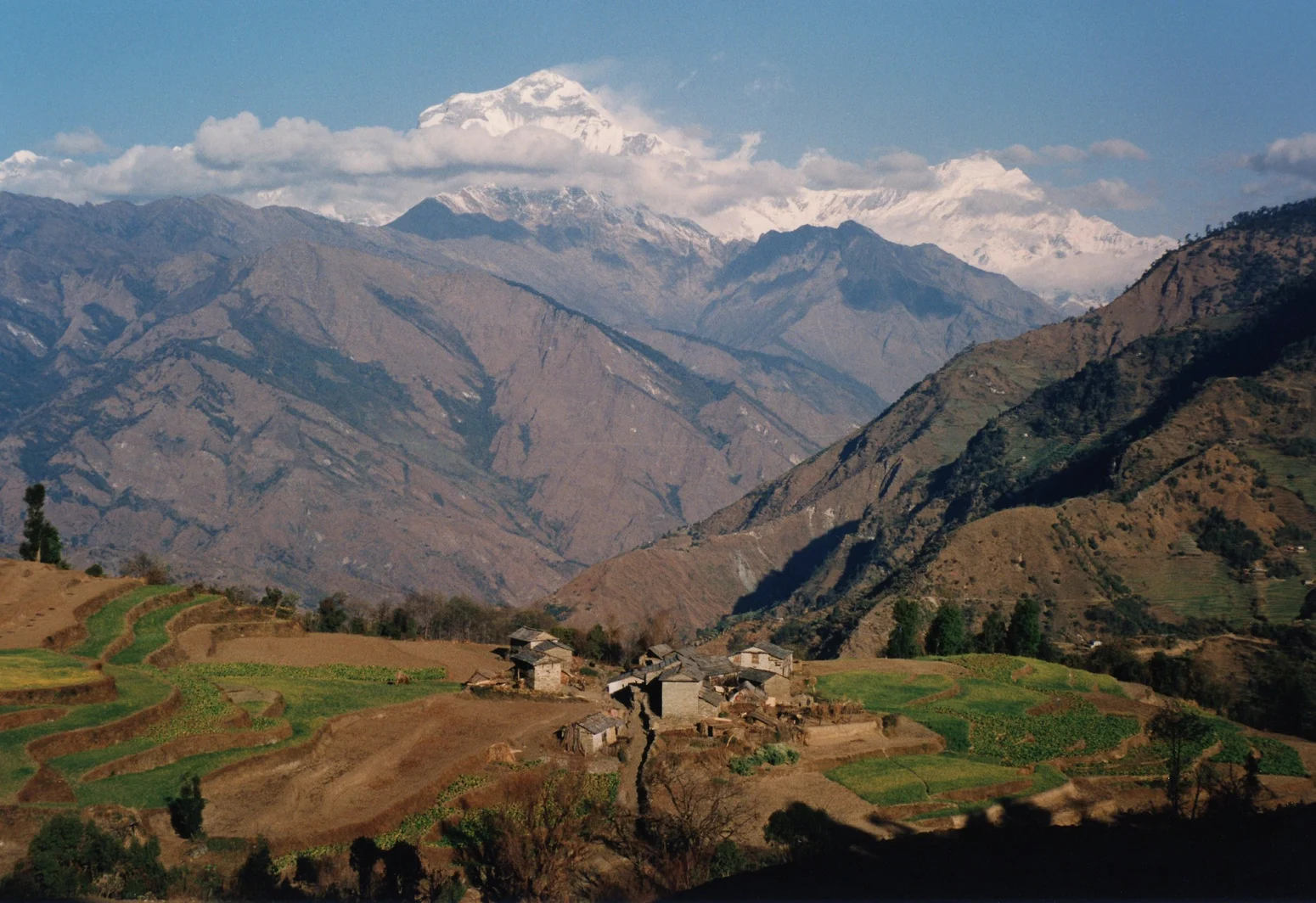
A Massif That Stopped Every Comers for a Decade
Dhaulagiri I sits northwest of Pokhara as the centrepiece of its own himal. The French expedition of 1950 — the team that would go on to make the first ascent of an eight-thousander on nearby Annapurna — reconnoitred it first and turned away. A series of later expeditions through the 1950s approached the mountain from different angles without achieving the summit. The eventual first ascent came from a multinational group assembled by Swiss expedition leader Max Eiselin in 1960.
The northeast ridge defines the mountain's character as a technical and logistical problem rather than simply an altitude challenge. Its length and exposure meant that placing and supplying high camps was as consequential as the climbing itself, a reality that shaped every decision Eiselin's team made in the approach phase.
Aviation and Overland Plans in the Approach
Among the more distinctive elements of the 1960 expedition was the deployment of a Pilatus Porter aircraft named Yeti. The plane brought climbers and supplies to Dapa Col and the northeast col, while plans called for porters to carry supplies over Dapa Col and French Col. A mechanical failure forced an initial switch to land transport; after repair the plane crashed near Dapa Col, though the pilot and mechanic escaped without injury. The expedition continued using the overland system and did not abandon its objectives.
The coexistence of aerial and foot-based supply planning illustrates how early-1960s Himalayan expeditions were beginning to test mechanised logistics against the constraints of high-altitude terrain, without yet being able to rely on aircraft as anything more than a supplement to human carrying capacity. The crash demonstrated both the ambition and the fragility of that approach, and the team's ability to absorb the setback and continue speaks to the depth of its contingency planning.
The First Ascent: Two Summit Parties, One Route
On 13 May 1960, six climbers reached the summit of Dhaulagiri I via the northeast ridge: Ernst Forrer, Albin Schelbert, Peter Diener, and Kurt Diemberger from the climbing team, joined by Sherpas Nima Dorje and Nawang Dorje. Diemberger has noted that his group made the ascent without supplemental oxygen, placing the climb within the contemporaneous debate about what was physiologically possible near 8,000 metres. A second summit party followed on 23 May, when Hugo Weber and Michel Vaucher repeated the route.
The two-party structure of the ascent reflected the expedition's logistical depth: enough rope, supplies, and personnel had been moved onto the mountain to support a second attempt after the first had succeeded. That capacity was built through a combination of aerial resupply and overland porter work.
Standing in the Dhaulagiri Himal
Dhaulagiri I's elevation of 8,167 metres places it seventh among the world's highest summits. It stands as the principal peak of a massif northwest of Pokhara.
The French reconnaissance of 1950, the subsequent attempts through the 1950s, and the 1960 first ascent have given Dhaulagiri I a specific place in Himalayan history. The Swiss-led team that finally succeeded did so with a plan flexible enough to survive the loss of its own aircraft and still put climbers on the summit twice.