
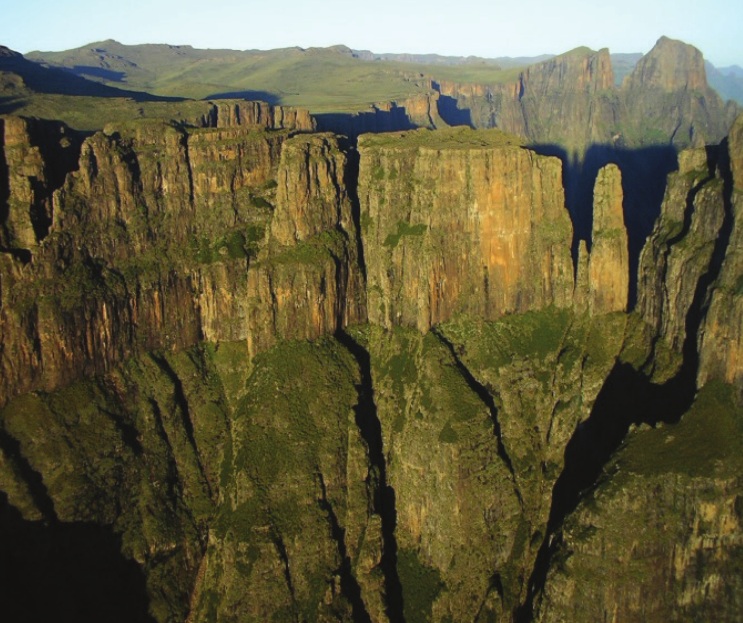
First Ascent, 11 August 1950
South African History Online records the first ascent of Devil's Tooth on 11 August 1950 by E. Scholes, D. Bell, and P. Campbell. Pearse's 1973 Alpine Journal account assigned the route a grade of G within the historical grading system then in use for the Natal Drakensberg.
Basalt Pinnacle Form Within the Amphitheatre
The pinnacle occupies a position between Eastern Buttress and Inner Tower along the Amphitheatre's southern arc, its narrow profile making it visually distinct from the broad cliff faces on either side. The geology is basalt characteristic of the upper Drakensberg formation, shaped by differential erosion that isolated the column from the main escarpment wall.
Esterhuysen's 1963 Botanical Collection in Devil's Tooth Gully
In July 1963, botanist Esterhuysen collected a vouchered specimen of Selaginella from Devil's Tooth Gully, a site in the gully distinct from the summit. The collection is cited in Bothalia but was not published there in 1963. The gully offers localised shelter and moisture that support fern allies such as Selaginella.