
Volcanic Setting and Elevation
Taveuni's volcanic history is characterised by fissure eruptions and a succession of youthful cones and tephra deposits, as documented by the Smithsonian Global Volcanism Program and a detailed hazard study produced for the South Pacific Applied Geoscience Commission. Des Voeux Peak is one of the named cones within this system. The Smithsonian rounds the peak's elevation to approximately 1200 metres; the figure of 1195 metres derives from a Massey University South Pacific geoscience field study that examined summit deposits directly. A GLO-30 derived summit cell places the high point at 1191 metres at 16.844167°S, 179.966667°W, and an AntWeb upper-slope field collection recorded an elevation near 1188 metres at a site on the mountain. The Smithsonian's coordinates for the volcanic feature are approximate and plot somewhat north of these field positions.
The stratigraphy documented at and around Des Voeux Peak reflects local deposit sequences rather than island-wide eruption events; primary research by Cronin and Neall examined the broader impacts of Taveuni volcanism on the surrounding environment and provides context for interpreting the cone within the island's eruptive succession. Care is required when attributing any deposit age or eruption date specifically to Des Voeux, as opposed to the wider Taveuni volcanic field, without direct stratigraphic evidence from the summit itself.
Montane Forest and the Tagimoucia Lake
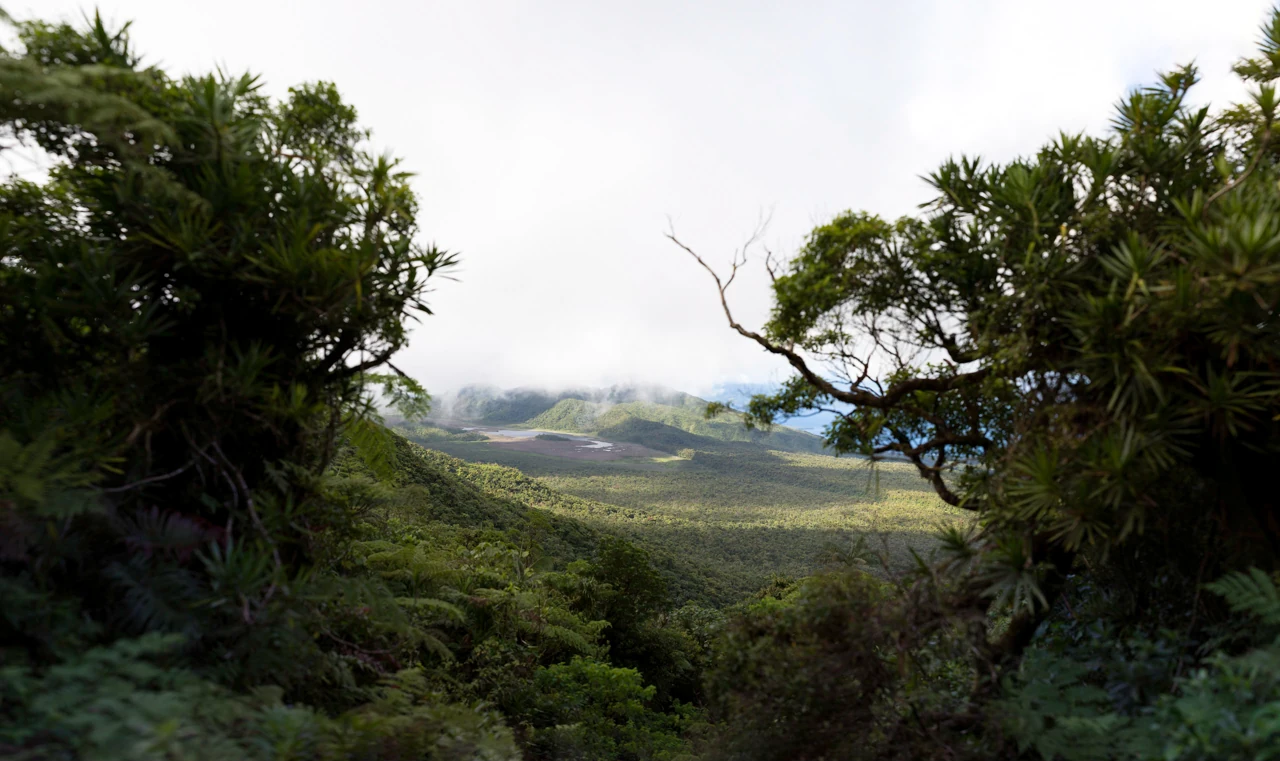
The upper slopes of Des Voeux Peak carry montane forest, and a photograph associated with 2024 biological research at the mountain shows the view from Des Voeux across forested terrain toward Lake Tagimoucia.
New Bee Species from the Slopes
Field collectors working a track below Des Voeux Peak gathered specimens subsequently described as two bee species. Hylaeus apertus was collected on 29 April 2019 at 872 metres, and Hylaeus veli on 19 April 2019 at 875 metres, both on flowering Metrosideros collina along the Des Voeux track. Dorey and colleagues published the formal descriptions in 2024. The authors explain that the name H. veli draws on a reference to forest beings in Fijian folklore, as noted in the species description itself.
The same upper-slope environment has drawn myrmecological fieldwork: AntWeb records a georeferenced ant collection from a site identified as Mt. Devo at approximately 1188 metres on Taveuni, using a local rendering of the peak's name. Together, the bee and ant collection records establish Des Voeux Peak as a site of active invertebrate biodiversity research, with montane Metrosideros forest providing the principal collecting habitat on the upper tracks below the summit.