
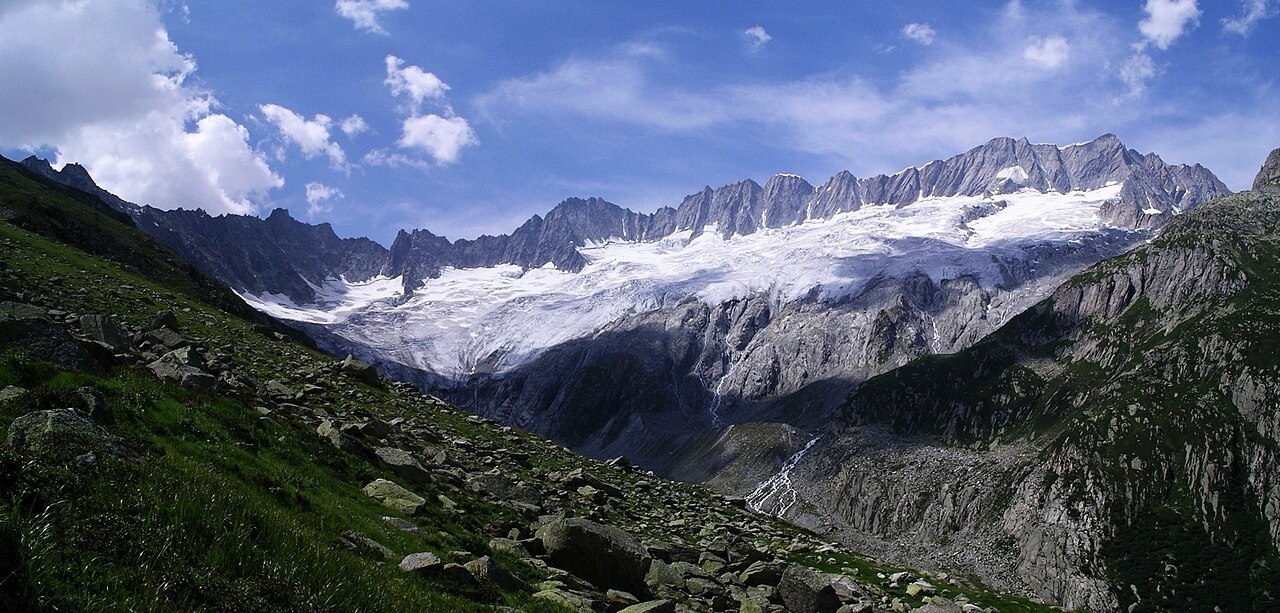
A Peak of Two Faces
Dammastock rises to 3,630 metres on the eastern edge of the upper Rhone Glacier, positioned where the Urner Alps begin to yield to the broad snowfields that feed one of Switzerland's largest ice bodies. The Swiss Alpine Club draws a clear distinction between the two principal sides of the mountain: the west flank, which falls relatively gently toward the Rhone Glacier, and the east side, which drops sharply toward the Dammagletscher below. This asymmetry is not merely topographic — it defines the nature of travel on and around the peak, with the spacious western ice giving way abruptly to a considerably more demanding eastern face.
First Ascent and Early Exploration
The first recorded ascent of Dammastock took place in 1864, carried out by a party of three: A. Hoffmann, J. Fischer, and A. von Weissenfluh. The Swiss Alpine Club preserves this record, identifying the west flank and the Rhone Glacier approach as the line the party followed. The 1864 ascent places Dammastock within a mid-nineteenth-century wave of systematic first ascents across the Urner Alps, a period when local guides and visiting alpinists together mapped the high terrain that had previously been crossed only by necessity.
The Rhone Glacier in Long-Term Record
The Rhone Glacier, which spreads across the western base of Dammastock, is among the most thoroughly monitored glaciers in the Alps. The Glacier Monitoring Switzerland programme, known as GLAMOS, maintains reconstructed historical outlines of the ice body that allow researchers to track its changing extent across documented periods. These records concern the broad west-side glacier and should be read separately from observations of the Dammagletscher, the distinct ice body on the eastern flank. Together, the two glacial systems frame Dammastock from opposite directions and represent different scales of ice coverage, a distinction that matters both for scientific interpretation and for understanding the mountain's geography as a whole.