
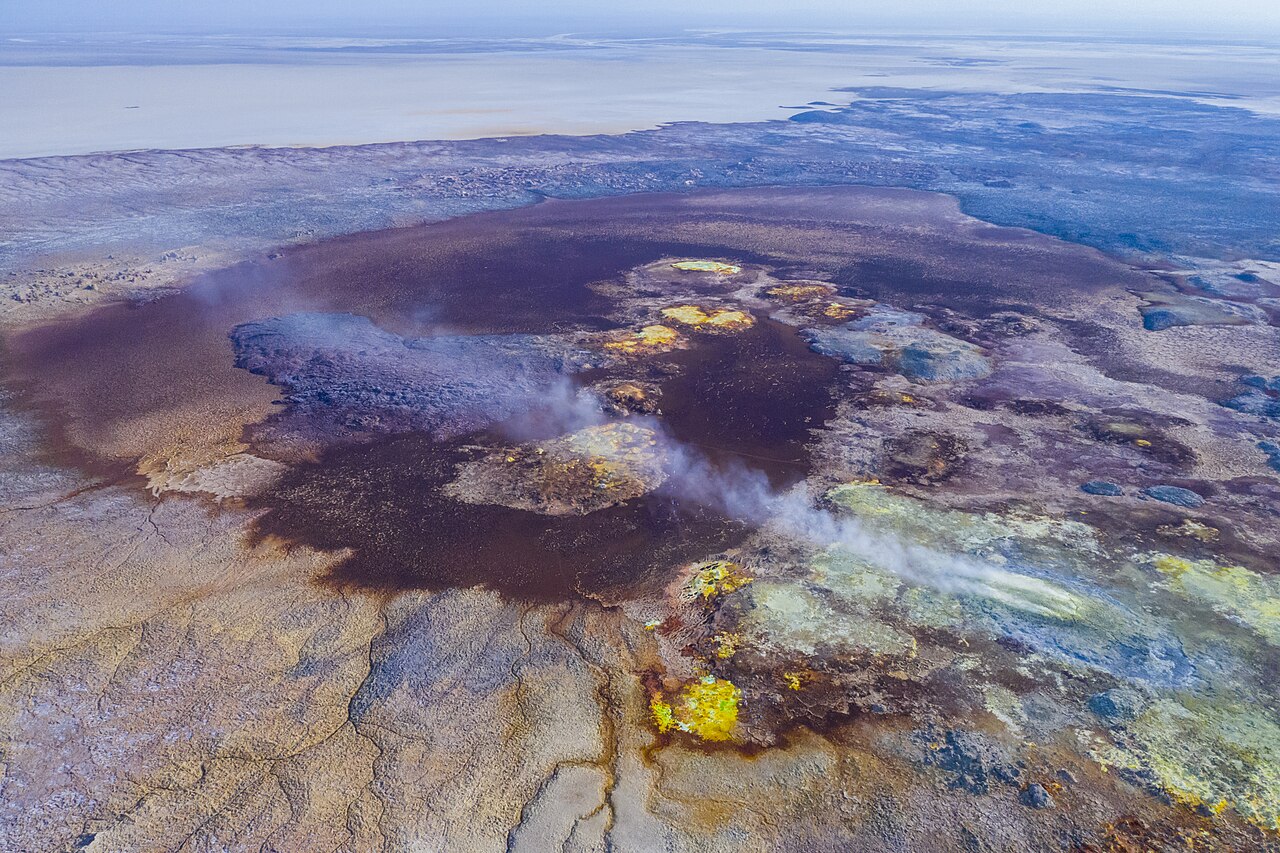
A Crater Born of Steam and Salt
The Smithsonian Global Volcanism Program attributes the formation of Dallol crater to a 1926 phreatic eruption, a steam-driven explosion rather than a conventional lava event, and records another phreatic explosion reported in January 2011. These dated reports establish a pattern of episodic hydrothermal violence rather than continuous volcanic effusion. The crater lies approximately 48 metres below sea level, an inversion of the conventional mountain form: the site's significance comes from what churns beneath the surface, not from topographic height.
Iron, Acidity, and the Chemistry of Colour
The terraces and pools of the Dallol hydrothermal field display intense yellows, greens, and ochres that have drawn considerable scientific attention. Research published in Frontiers in Microbiology identifies iron chemistry as a significant contributor to those hues, operating alongside the extreme acidity and high salinity that characterise the hot brines. The chemistry of the system varies across different pools and terraces, and the colours do not reflect any single uniform mineral signature.
Archaea and the Limits of Habitation
A 2019 study published in Nature Ecology and Evolution examined nearby habitats within the Dallol system and detected diverse archaea, single-celled microorganisms belonging to one of life's three domains, in some locations. The same study found no evidence of active life in certain extreme brines within the sampled system, where the combined acidity, salinity, and chemistry appeared to exceed thresholds tolerated even by extremophiles. That finding applies to the specific habitats and conditions sampled in the study and does not extend to the entire Dallol field.