
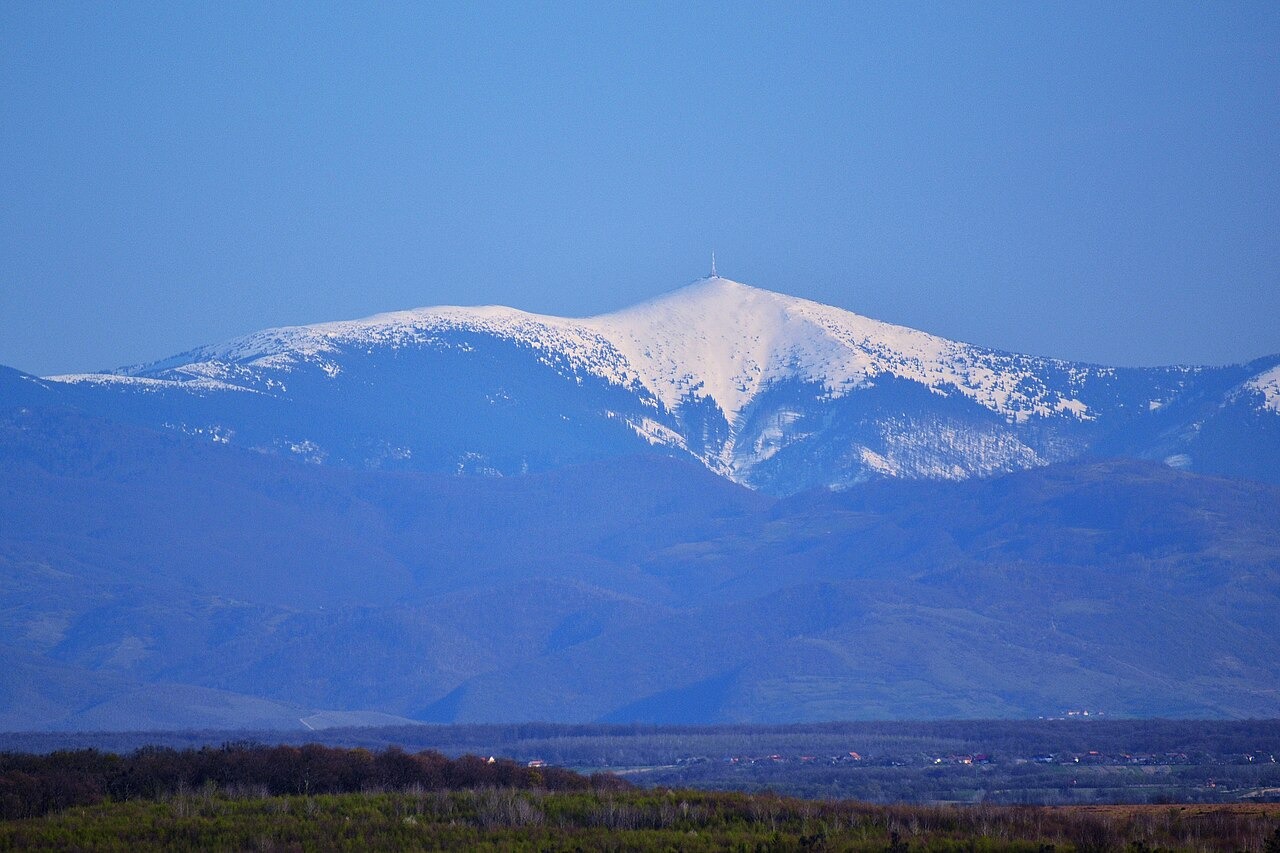
Summit Relay and Long-Distance Silhouette
The Bihor County Mountain Rescue guide for the Cristior approach notes the arrival at a broadcast relay station on the summit of Cucurbăta Mare. This structure gives the peak a distinctive profile visible from considerable distances, with the relay and summit silhouette identifiable from Josani in Bihor County, approximately 43 km away. The guide describes wooded approaches from villages west of the peak leading to the relay at the summit.
Summit Ridge Habitats and Recorded Flora
In June 2006, bryophyte researchers conducted a field inventory across the summit ridge and flanks of Cucurbăta Mare, with findings published in 2017. At 1,840 m on the summit ridge they recorded subalpine grassland and granitic scree, at 1,830 m they documented a granitic cliff face, and at 1,690 m in the saddle a dripping granitic rock habitat associated with melting snow. On the northeast flank, in the glacial Valea Cepilor, the same team observed dwarf pine, streamlets, and bogs, vegetation distinct from that of the exposed ridge above.
Granite Bedrock and Surrounding Karst
The study's appendix also records beech and fir forest on schist in the headwaters of Crișul Negru, on the northwest slope at 1,050 m. The broader Apuseni range includes extensive karst terrain, with plateaus and caves developed in limestone in massifs away from the upper reaches of Cucurbăta Mare.