
Two days in August 1884
On 3 August 1884 Karl Schulz's party reached the Cima di Mezzo. The Alpine Journal of the time records this as the first ascent of that summit. The party stopped short of the Cima Nord.
On 8 August, Schulz and the guide Matteo Nicolussi returned from the Cima Tosa. They traversed the ridge and touched the Cima Sud and the Cima di Mezzo before reaching the Cima Nord, the highest point of the Crozzon. The account notes the friable rock encountered on the descent to the notch between the middle and northern summits.
Two routes on the west face
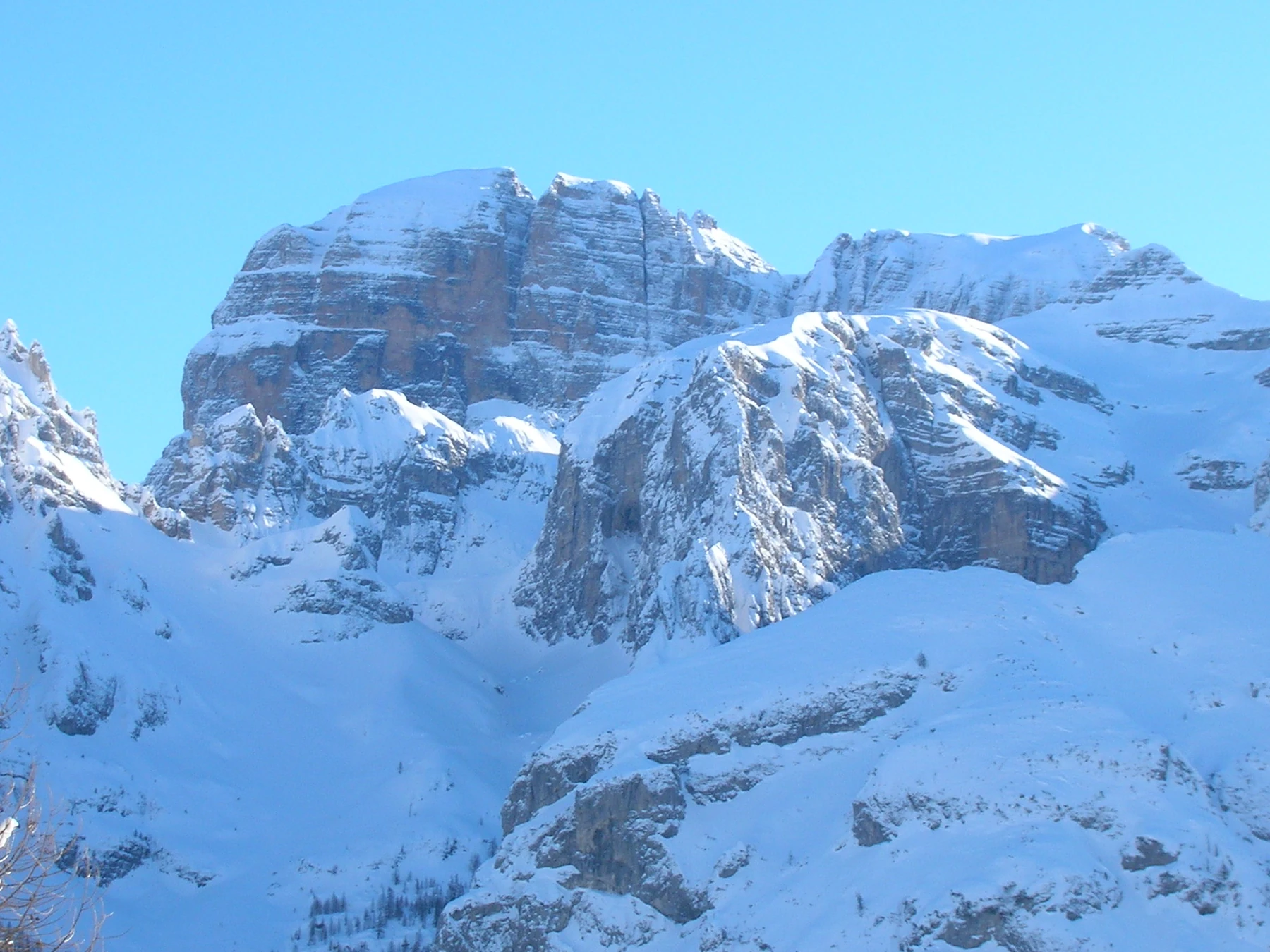
On 2 August 1933, Bruno Detassis and Ettore Castiglioni opened the first route up the centre of the west face, directly below the Cima di Mezzo. Their account describes the pitches linking the vertical cracks and ledges above the Vedretta dei Camosci.
Four days later, on 6 August, Matteo Armani and G. Giuliano reached the same summit by a largely different line. The two were unaware of the earlier ascent. In 1934 the Rivista mensile del Club Alpino Italiano published both accounts together with a photograph by E. Pedrotti on which both lines were marked.
A bivouac on the ridge and the glacier at the base
In 1957 the Società degli Alpinisti Tridentini built a bivouac on the Cima Nord to shelter climbing parties on the faces of the Crozzon. It was named after Ettore Castiglioni, who had opened the 1933 route with Detassis and written a guidebook to the Brenta Dolomites.
The Vedretta dei Camosci lies at the base of the west face. In the limestone and dolomite rock of the Brenta, part of the meltwater drains deep through fissures. In 2022 the glaciological commission of the Società degli Alpinisti Tridentini included the glacier in its surveys.