
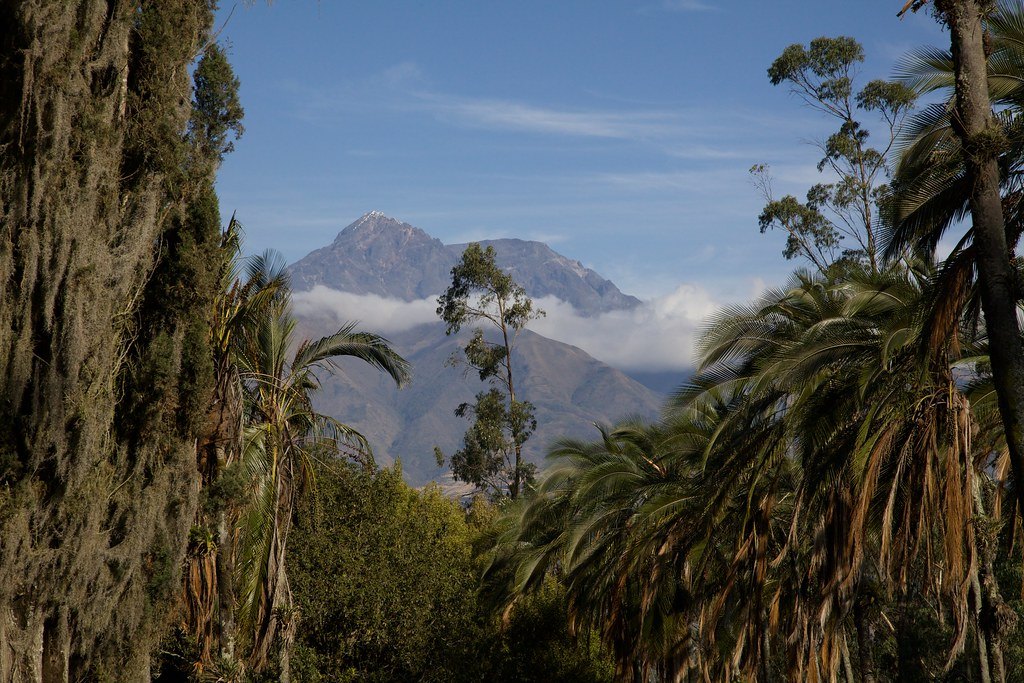
The high edifice of Cotacachi: steep flanks and Pleistocene origins
Cotacachi is a stratovolcano with pronounced flanks whose main construction dates to the Pleistocene. The IG-EPN describes it as the dominant edifice of a complex grouping several eruptive centers, Cotacachi being the oldest and highest of them.
The date of the last eruption of the Cotacachi edifice is unknown according to the IG-EPN. The well-dated eruptive events in this complex belong to the Cuicocha volcanic center and not to the main edifice.
Cuicocha: caldera, lake, and dacitic domes
To the south of the Cotacachi summit, within an independent and younger eruptive center, the Cuicocha caldera opens. The IG-EPN describes its origin as beginning with the initial growth of a volcanic dome on that flank, followed by a large explosive eruption approximately 3,100 years ago that formed the present caldera.
Within and around that lagoon, the IG-EPN documents the presence of dacitic domes that emerge partially above the water surface or remain submerged. These domes are morphological features of the Cuicocha center and not of the Cotacachi edifice.
A volcanic complex with an eruptive history differentiated by center
Cotacachi and Cuicocha are distinct centers within the same volcanic complex of the Cordillera Occidental. Cotacachi is the oldest and highest edifice in the complex. Cuicocha is a younger center with a caldera, lake, and dacitic domes documented by the IG-EPN.
The caldera, the lake, and the dacitic domes belong to the Cuicocha center. The 4,939-meter summit belongs to the Cotacachi edifice, whose eruptive history remains undated according to the IG-EPN.