
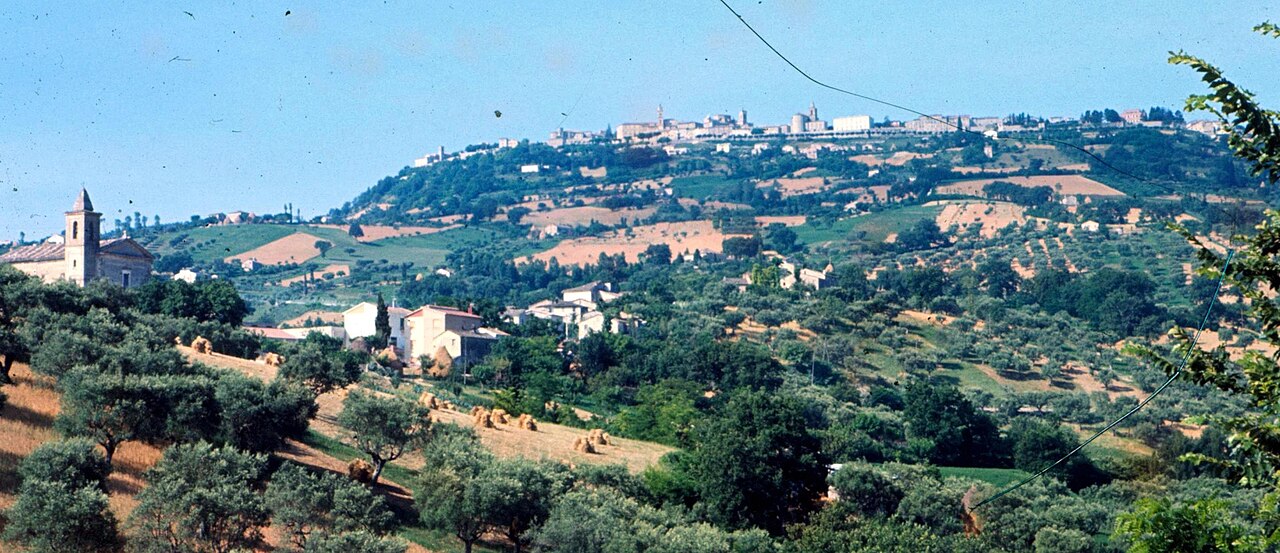
The Balcony of the Marche
The regional landscape plan for Marche characterises the Cingoli ridge as standing above clay hills that descend toward the Adriatic, with an intermediate zone of cultivated marl and sandstone terrain between the ridge foot and the coast. The regional tourism guide documents a viewpoint from the town that takes in Monte Conero and the Adriatic on one side and the Apennine chain on the other.
Celso Mosca's archive photograph records the ridge from below, looking upslope at the crest where the town sits, its structures framed against the sky above cultivated hillside. The slope visible in that image reflects the agricultural character the landscape plan assigns to this intermediate zone.
Folded Carbonates and the Formation of the Ridge
Research published in Solid Earth in 2021 by Lacombe and co-authors identifies the Cingoli anticline as a fold within a marine carbonate sequence. Rocks originally deposited in a shallow marine carbonate environment are overlain by finer sediments characteristic of deeper, more offshore conditions. Dated strata from the adjacent Aliforni syncline place the formation of both the Cingoli and San Vicino anticlines in the late Messinian to early Pliocene, approximately 6 to 5 million years ago.
Ancient Cingulum and the Slope Settlement at Borgo San Lorenzo
Strabo, in Geography 5.2.10, names a Mount Cingulum in his description of Ombrica, and Roman authors such as Caesar place the associated settlement in Picenum, which covered much of today’s Marche. The National Archaeological Museum of Cingoli connects the Roman town of Cingulum to Borgo San Lorenzo, a site on the slope northeast of the present summit settlement, where Roman-period finds have been recovered.
In Civil Wars 1.15, Caesar records receiving a delegation from the town during his descent into Picenum in 49 BCE and associates its construction with his former legate Titus Labienus. The Roman material at Borgo San Lorenzo and the medieval fabric concentrated at the 631 m summit represent physically distinct layers of occupation on the same landform.