
From a colonial decree to an Algerian national park
The French colonial administration laid the first groundwork for protecting the site through a decree of 3 September 1925, according to a study by the History Committee of the ministry responsible for the environment. The Algerian framework took over with Decree No. 83-461 of 23 July 1983, published in the Algerian Official Gazette, which formally established Chréa National Park.
In 1932, Le Chantier nord-africain described a mountain village situated at around 1,500 m altitude, where the Ski Club refuge had already become too small to accommodate the competitions then being held on site. The journal also reported the first plans for a cooperative hotel intended to overlook the Mitidja.
Biosphere reserve and water resource
In 2002, UNESCO recognized the site as a biosphere reserve, covering an area of 38,091 hectares according to UNESCO. The organization underlines the massif's importance for the water supply of Blida and other towns in the region, a role to which the forests and catchment basins of the Chiffa and El Kébir wadis contribute.
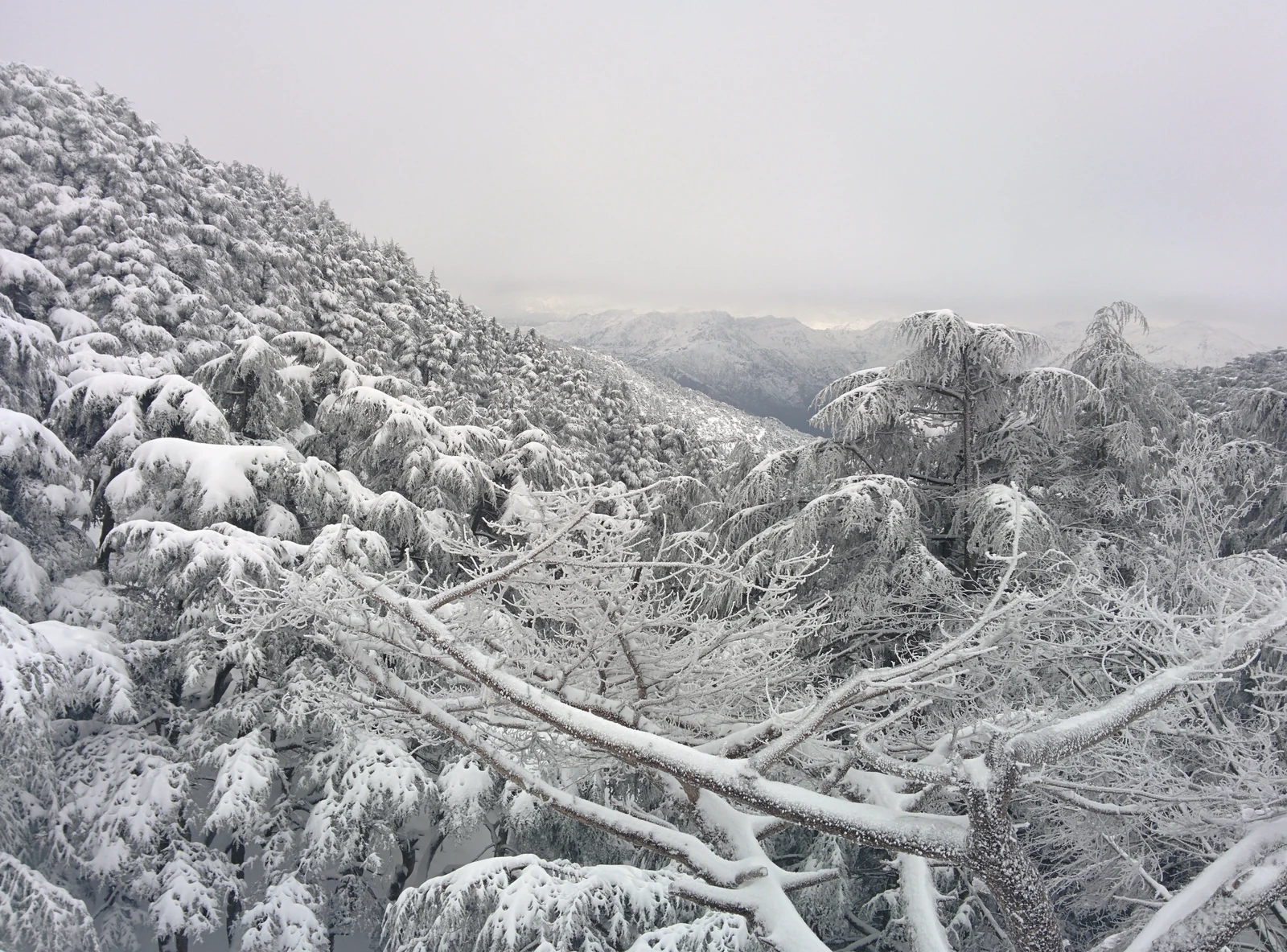
The Algerian Space Agency compared satellite images acquired in 1987, 2001, and 2004: its analyses note significant urban expansion in the Mitidja plain, particularly visible in the 2004 scenes. A geolocated photograph taken on 30 December 2014 at coordinates 36.426338 N / 2.877318 E shows the trees and slopes under snow, on the forested hillsides of Chréa.
Cedar forest dynamics and pine processionary caterpillar infestations
Sbabdji and colleagues extracted, in late 1994, cores from thirty trees per site at three cedar forest stations in order to measure annual growth through ring analysis. Two of the sites, south-facing, had been subject to attacks by the pine processionary caterpillar (Thaumetopoea pityocampa); the third, cooler and more humid, located on a north-facing slope, served as a reference. The authors cross-reference the rings with forestry reports and infestation records. The study covers three episodes between 1973 and 1994, the most recent of which spans 1991 to 1993.
The study published in 2009 compares these chronologies to estimate the growth slowdown of the sampled cedars during the infestation periods.