
Landform and Neighbouring Summits
The Monk’s Cowl visitor guide from Ezemvelo KwaZulu-Natal Wildlife labels three distinct summits. From the eastern foreground toward the escarpment they are Cathkin Peak (3,148 m), Monk’s Cowl (3,229 m) and Champagne Castle (3,377 m). The first and last have broad tops. Reginald Pearse’s 1973 account likewise places Champagne Castle on the main escarpment, behind the outlying peaks.
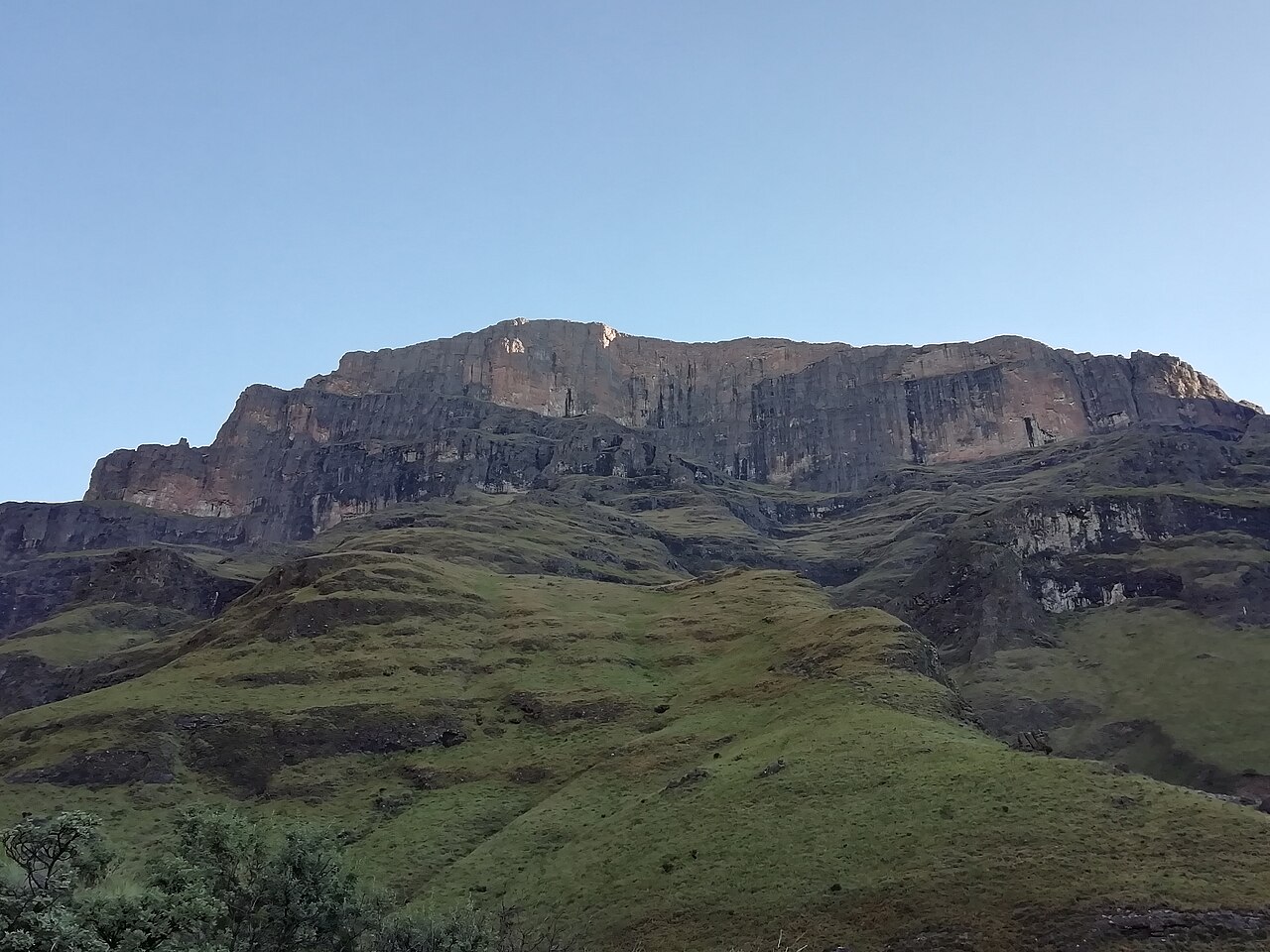
Stewartmoss photographed the escarpment from Keith Bush Camp, in the valley below. The red-brown wall in the photograph gives a sense of what the view compresses: the ridges, the cliffs and the higher plateau behind them.
Climbing Record and Early Accounts
In the Alpine Journal of 1888, A. H. Stocker described an ascent on 26 April. He and his younger brother approached by an eastern spur, climbed through steep gullies and returned after dark. Stocker recorded 11,355 feet on his aneroid barometer. The account preserves what one climber measured with a portable instrument in 1888.
An Alpine Journal report in 1912 still treated Cathkin Peak and Champagne Castle as two names for the same mountain. The journal’s 1915 report on the first ascent of Cathkin Peak put Monk’s Cowl between the two and explicitly separated their names.
Type Locality and Taxonomic History
In 1947, V. F. M. FitzSimons described the frog Phrynobatrachus lawrencei from a specimen collected near Champagne Castle at about 7,000 feet. In 1964, J. C. Poynton treated that name as a synonym of a frog George Boulenger had described in 1920. The American Museum of Natural History lists the accepted name as Amietia hymenopus. It records Champagne Castle as the type locality for FitzSimons’s name, and gives the locality of Boulenger’s original specimen simply as South Africa.
UNESCO World Heritage Designation
UNESCO added the South African uKhahlamba-Drakensberg Park to the World Heritage List in 2000, recognising both its natural habitats and its San rock art. In 2013, the World Heritage Committee extended the site to include Sehlabathebe National Park in Lesotho. The two countries now share the Maloti-Drakensberg Park World Heritage property.