
Geography: rock, ice, and wind
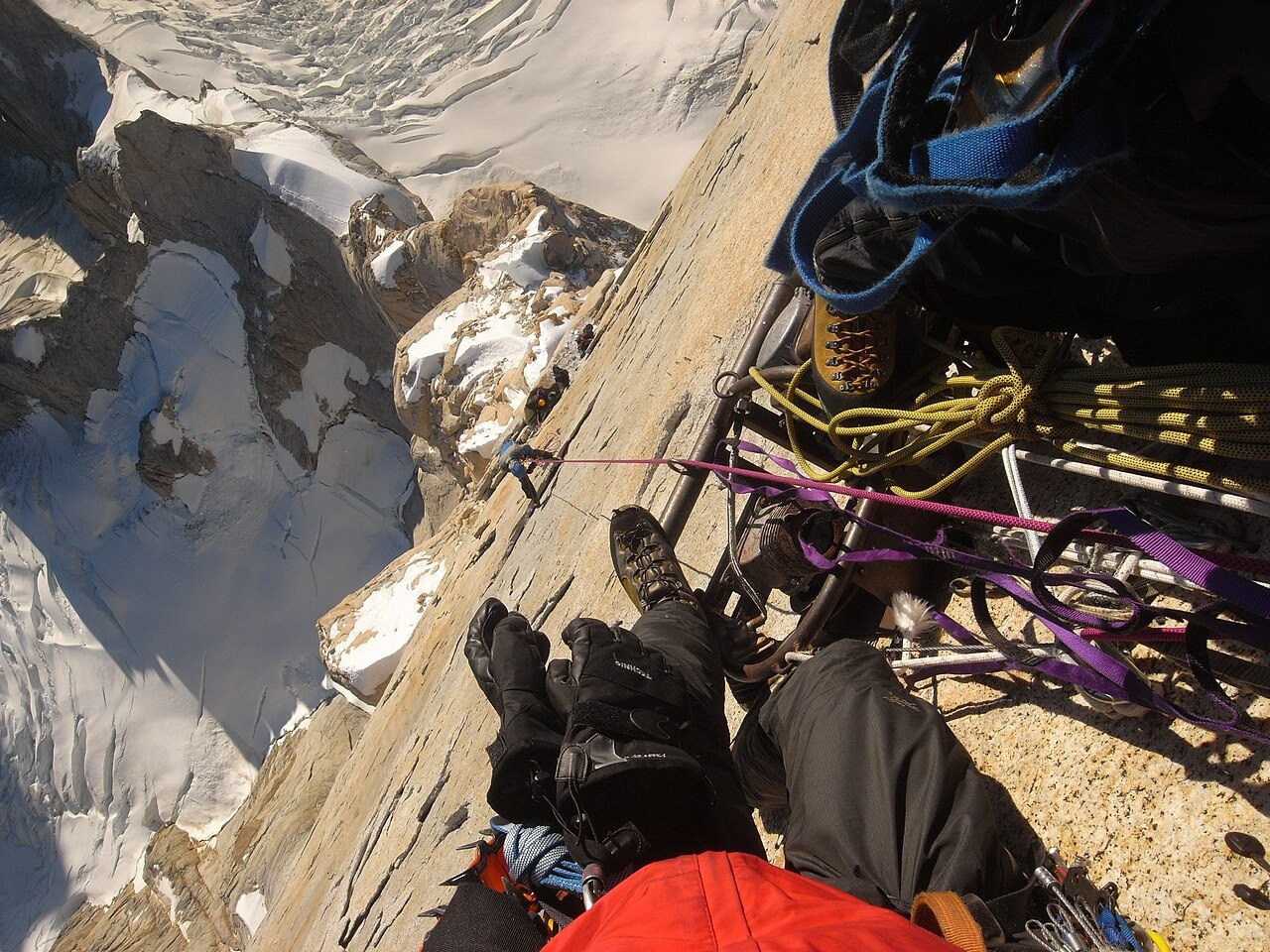
Cerro Torre lies near the town of El Chaltén, in the Argentine province of Santa Cruz, forming part of the cluster of granite towers that border the Southern Patagonian Ice Field. UNESCO, which recognizes Los Glaciares National Park as a World Heritage Site, highlights in its description the active glaciation shaping the landscape and the singular character of its granite summits. The result is a silhouette that changes constantly: depending on light and ice cover, the needle may appear bare or crowned by a rime mushroom — the ice accumulated by the prevailing westerly winds that gives the peak part of its unmistakable character.
Climbing history
The first documented attempt on Cerro Torre was made by Cesare Maestri and Toni Egger in 1959. The expedition ended in tragedy, and whether they reached the summit remains disputed to this day; the APN Management Plan records the attempt without validating the ascent. In 1970, Maestri returned with a motor-driven bolt gun to open a new line, an episode that reignited controversy over legitimate means in high-altitude climbing. The milestone most firmly accepted by mountaineering historiography is the 1974 ascent by the Ragni di Lecco route, carried out by D. Chiappa, M. Conti, C. Ferrari, and P. Negri. In 1987, Sebastián de la Cruz completed the first documented Argentine summit, according to the same source.
These dates and names are more than chronological data: they articulate decades of debate about ethics, technology, and the very nature of cutting-edge alpinism. Cerro Torre has functioned, in that sense, as a testing ground for ideas that subsequently spread throughout the global mountaineering community.
The trail to Laguna Torre: the mountain from the plain
The APN Management Plan mentions the trail to Laguna Torre as one of the routes that allow visitors to view Cerro Torre and the neighbouring needles. From the glacial lake, the group of towers — with their smooth granite flanks and the tight glaciers descending between them — presents a panorama that concentrates the visual essence of the area: the contrast between the dark glacier-fed water, the blocks of ice that may float at the shore, and the vertical walls rising as far as the clouds allow. The silhouette of rock and ice visible from this point is precisely what has drawn mountaineers from around the world, and what the park — integrated into UNESCO's world heritage network — seeks to preserve.
Heritage and management
Los Glaciares National Park, administered by Argentina's Administración de Parques Nacionales, places Cerro Torre within a protection framework that encompasses glaciers, lenga beech forests, and the geomorphological dynamics characteristic of the boundary between the Andes and the Patagonian steppes. The 2019–2029 Management Plan reflects the ongoing tension between the landscape and scientific value of the area — recognized by UNESCO since 1981 — and the growing pressure from tourism and elite mountaineering. For the mountain that has perhaps generated more controversy than any other in the history of modern alpinism, that tension between use and conservation is not incidental: it is part of its identity.