
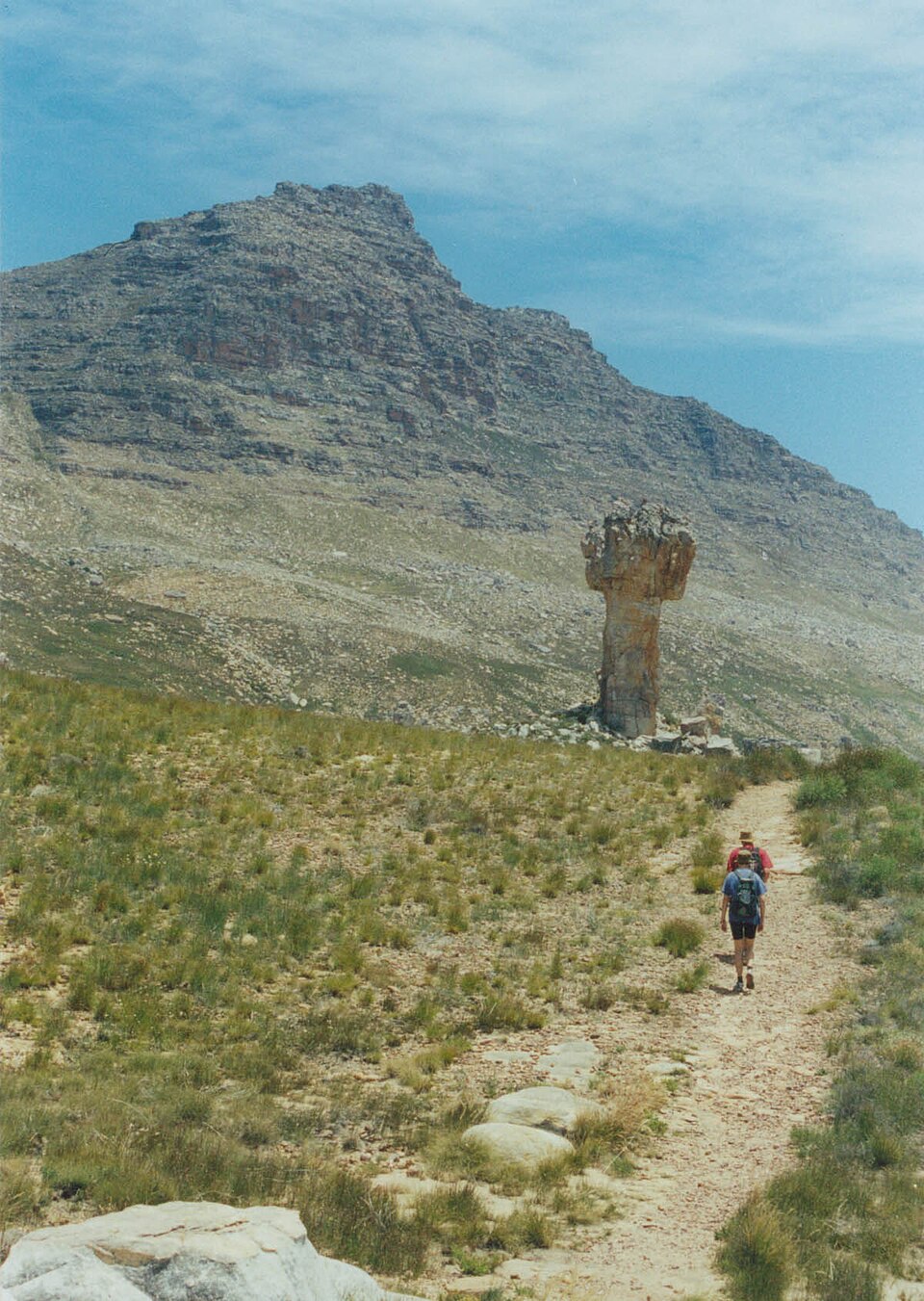
Table Mountain Sandstone Terrain
The upper Cederberg is characterised by rugged Table Mountain sandstone formations that shape both the topography and the soils. CapeNature's management documentation describes the wilderness as a mosaic of rocky outcrops, shallow soils, and fynbos vegetation adapted to the nutrient-poor, acidic substrate. These conditions define the ecological character of the range from the lower valleys to the summit zone.
Snow Protea Habitat on the Upper Slopes
The rocky uplands around Sneeuberg fall within the restricted habitat of Protea cryophila, the snow protea. The South African National Biodiversity Institute documents the species as confined to upper Cederberg elevations. The Mountain Club of South Africa conducted a dedicated field outing to Sneeuberg in search of Protea cryophila, describing the club's engagement with the plant's limited and specialised environment on the high ground.
Cederberg Wilderness and World Heritage Context
CapeNature administers the Cederberg Wilderness under provincial conservation authority. The area forms one protected component within the broader Cape Floral Region Protected Areas, a serial World Heritage property first inscribed by UNESCO in 2004 in recognition of the region's exceptional plant diversity and the concentration of endemic fynbos species across its constituent sites.