
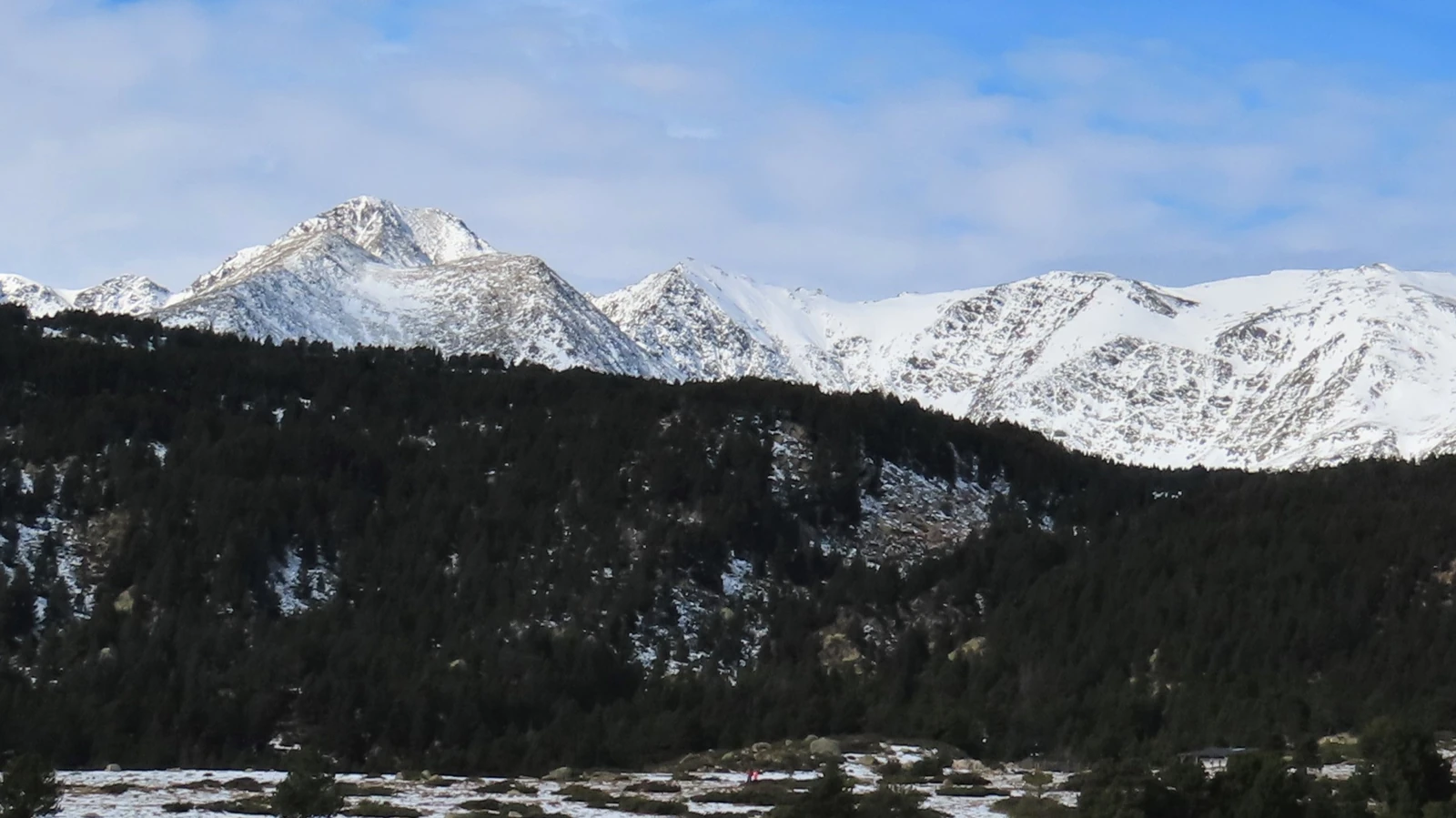
Three summits on the same ridge
The ridge extends from the main Carlit to the Puig de Sobirans (2,785 m), passing through the Carlit de Baix. In the photograph taken from the Bolosseta, the Carlit de Baix is distinct from the main summit, which appears on the left.
On 14 March 2009, Paco G. and Ferran B., from the Centre Excursionista de Gràcia, described a ski crossing from Les Angles via the Carlit de Baix before reaching the main summit. In October 2023, another field account follows the ridge in the opposite direction, from the main summit to the Puig de Sobirans.
The traces of ice at the Coma dels Forats
In a study published in 2005 in Quaternaire, Magali Delmas reconstructed several former glacier positions from moraines, the deposits left behind by ice. In the Coma dels Forats, one of these deposits places the front of a former glacier tongue at around 2,280 m. The higher moraines attest to a retreat towards the cirques and the break-up of glaciers that had previously merged.
The Bouillouses and the electricity supply of the Train Jaune
At the foot of the plateau, the State and the Compagnie du Midi oversaw the construction of the Bouillouses dam and the La Cassagne power station between 1904 and 1910. The latter supplied electricity to the Train Jaune, whose section between Villefranche-de-Conflent and Mont-Louis opened in 1910.
The small lakes on the plateau occupy basins of glacial origin. Below, the Bouillouses reservoir was created by the dam on the Têt. The Bouillouses area was designated a protected natural site on 24 June 1976.