
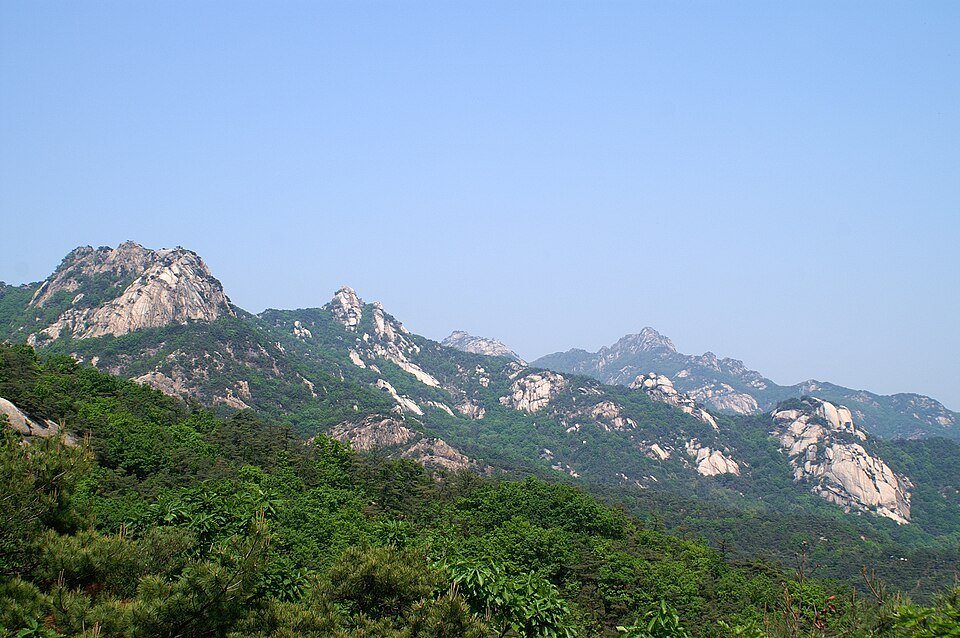
The three peaks that make up Samgaksan
The highest point of Bukhansan is Baegundae. The Korea Tourism Organization gives its elevation as 835.6 m; on maps, the rounded figure of 836 m is commonly used. Insubong and Mangyeongdae rise alongside Baegundae, making the outline of all three peaks clearly visible from a distance.
The Korea National Park Service's Baegundae course follows a rocky trail to the summit. The gradient steepens below Baegundae, and the views open toward Seoul and Gyeonggi from the top. A defining feature of this route is the way the panorama, partly screened by trees lower down, gradually widens as you approach the summit.
1711: a fortress built along the ridgeline
In 1711, King Sukjong of Joseon ordered the construction of Bukhansan Fortress to the north of Hanyang. The fortress was planned as a refuge where the king, government offices, and residents could shelter and mount a prolonged defense in times of emergency. Military units and monk soldiers took part in the construction, and the walls extended approximately 11.6 km along valleys and ridgelines.
Walking the ridgeline paths between the gates makes it easy to understand why the steep rock faces became part of the defensive line. High vantage points commanded the approaches, while gates and passageways were placed on the valley sides. Daenamun is a point where the relationship between the ridgeline and the fortress wall can be clearly seen on a trail map.
The route to the summit and reading the fortress walls
The approach toward Baegundae is well suited for understanding the relationship among the three peaks and the gradient of Bukhansan's upper section. If the structure of the fortress interests you, place the ridge gates — such as Daenamun and Daesongmun — alongside the valley-facing Daeseomun on a map. By tracing where the walls rise higher and which valleys they cross, the Joseon defensive system becomes tangible from the trail.