
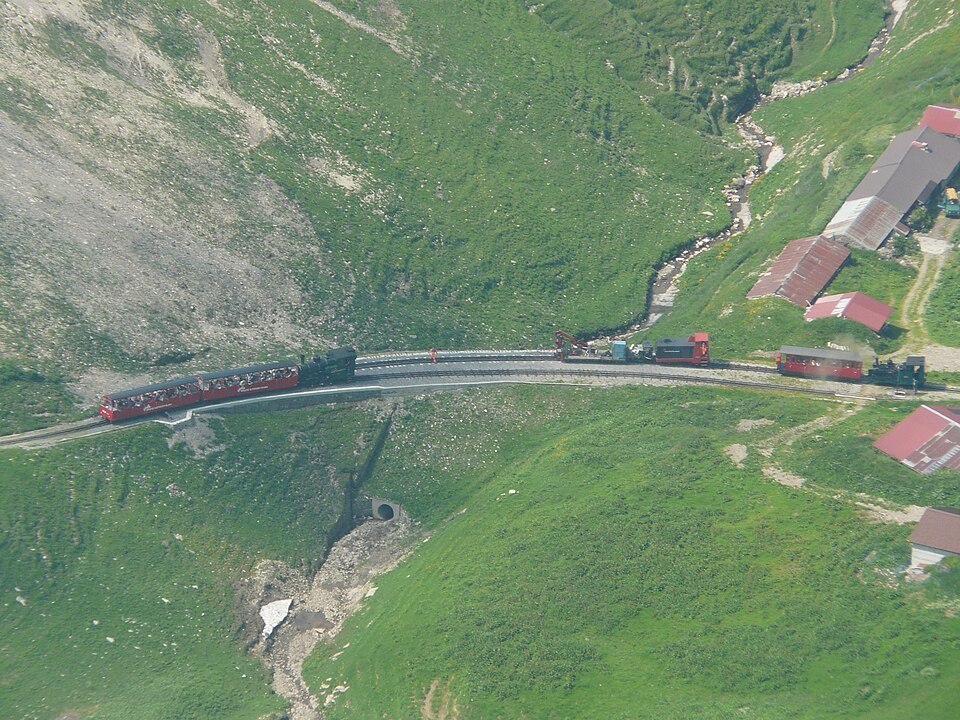
Building the Line: Sixteen Months and Seven Hundred Workers
Constructing the rack railway from the valley to the high ridge took approximately sixteen months and required a workforce of around 700 people, a substantial portion of whom came from Italy. The company records a formal opening date of 16 June 1892. The scale of that effort reflects both the engineering ambition of late-nineteenth-century Swiss mountain railway projects and the degree to which they drew on regional labour networks that crossed national borders. The resulting line climbs a gradient steep enough to require a rack mechanism throughout its length.
How a Rack Railway Maintains Grip
A rack railway adds a toothed rail laid centrally between the running rails, and the locomotive carries a cogwheel that meshes with this rack. On a conventional adhesion railway, traction depends entirely on friction between wheel and rail — a grip that becomes unreliable on steep gradients. By engaging mechanically with the rack rather than relying on surface friction alone, the locomotive can both climb and descend slopes that would cause an ordinary train to stall or slide. On a line like the Brienzer Rothorn railway, where the gradient is steep for much of the route, this engagement is continuous, and the rack is as fundamental to the line's operation as the track itself.
The Locomotive Archive and the Centenary Machines
The operator's locomotive archive records steam engines dating to 1891 and 1892, making several of the surviving machines contemporaries of the railway's opening season. These original locomotives were coal-fired and built to the specifications demanded by the rack system and the altitude. From the centenary of the line onward, oil-fired steam engines were introduced, extending the operational life of steam traction on the railway while shifting the fuel source. The archive thus spans more than a century of steam machinery, from the original construction fleet through the centenary-era additions, preserving a record of how the technology evolved while the fundamental principle of the rack remained unchanged.