
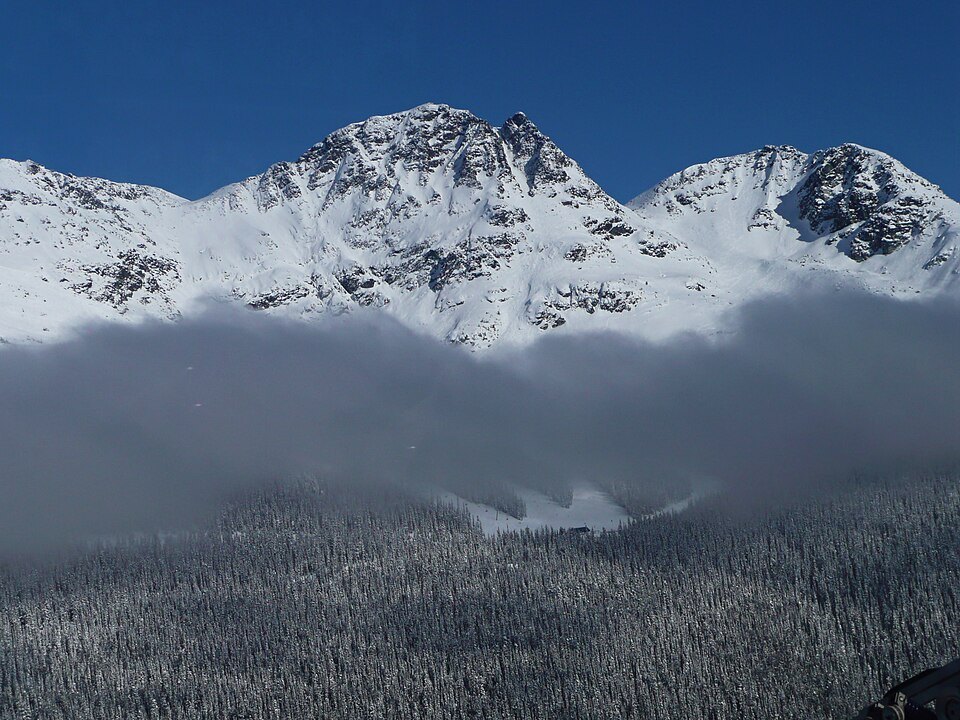
Position and Boundaries
The mountain sits at the edge of Garibaldi Provincial Park, forming a geographic and administrative boundary between the resort infrastructure of Whistler Blackcomb and protected provincial land. Whistler Village lies at the base of the face oriented toward Whistler Mountain, while Blackcomb Village sits below the opposite face. This placement means the ski lift network functions not only as resort infrastructure but as an access system for the park itself.
The Spearhead Traverse—a backcountry ski route that passes through Garibaldi Provincial Park—is among the routes for which Blackcomb's lifts serve as a common starting point. The mountain therefore operates at a practical junction between lift-served terrain and self-propelled wilderness travel.
Olympic History
The 2010 Winter Olympics sliding sports program was held on Blackcomb's slopes, at the Whistler Sliding Centre. Bobsleigh, luge, and skeleton events all took place at this venue, bringing international competition to terrain that otherwise functions as a ski resort mountain. The siting of a purpose-built sliding track on Blackcomb reflects the mountain's elevation and the consistent snow conditions produced by its climate regime.
Climate and Snowfall
According to the Köppen climate classification, Blackcomb Peak falls within the marine west coast climate zone of western North America. Weather systems originating over the Pacific Ocean move east toward the Coast Mountains, where the terrain forces them upward through orographic lift. This process causes the systems to release precipitation as rain or snowfall, and the Coast Mountains as a result receive notably high annual precipitation totals.
This orographic mechanism is the primary driver of Blackcomb's snow conditions. Moisture-laden Pacific fronts encounter the barrier of the Coast Mountains and deposit their load on windward slopes, making elevation and aspect the dominant variables in annual snowpack across the range.