
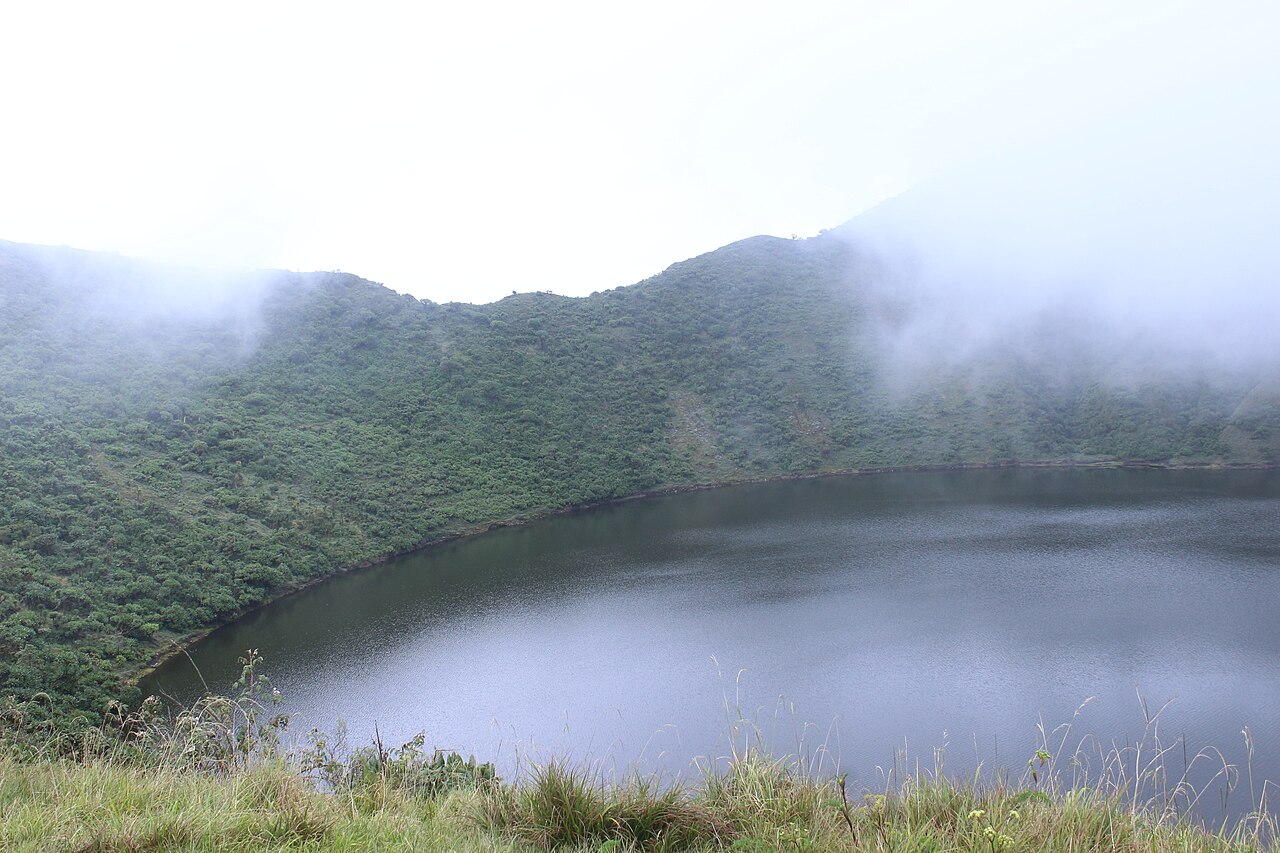
Volcanic Character and Flank Geology
Bisoke is composed primarily of trachyandesite, the volcanic rock type recorded by the Smithsonian Global Volcanism Program for this edifice. The flanks bear evidence of repeated eruptive activity: lava flows are present across the slopes, and a fissure zone extending northeast of the volcano includes a series of scoria cones. These features reflect the broader eruptive history of the Virunga volcanic field, where eruptions have recurred across multiple vents and rift-aligned fractures over geological time.
A documented eruption in 1957 produced two small cones on the northern flank, situated roughly 11 kilometres from the summit. This episode added to the structural complexity of the northern slopes. The crater lake at the summit is a distinct feature, approximately 450 metres across.
Position in the Virunga Range
The Virunga Mountains form a chain of volcanoes straddling the borders of Rwanda, the Democratic Republic of Congo, and Uganda. Bisoke sits in the southern part of this chain on the Rwanda–DR Congo border. Its neighbours include Karisimbi to the west, the highest peak in the Virunga Range. The elevation and volcanic soils of this corridor sustain the montane forest habitat that characterises the range.
The Karisoke Research Center
In 1967, the American primatologist Dian Fossey established the Karisoke Research Center in the saddle area between Bisoke and Karisimbi. The name Karisoke is a compound drawn from both mountains. The centre was founded as a field station dedicated to the long-term study of mountain gorillas. The Florida Museum documents Fossey's founding of the station and its research purpose within this geographic setting.
Fossey's work at Karisoke, carried out through direct observation in the high-altitude forests of the Virunga Range, contributed substantially to scientific and public understanding of mountain gorilla behaviour and social structure.