
Limestone Ridges and Glacial Cirques
The rock forming Bisaurín belongs to the high calcareous Pyrenees, composed largely of limestone of Late Cretaceous and early Paleogene age laid down tens of millions of years before the glaciations that shaped the present landforms. The Aragón Landscape Atlas identifies Bisaurín explicitly as an example of the glacial cirques that cut into these carbonate ridges, leaving the steep headwalls and hollowed basins characteristic of the high mountain zone.
The Spanish Geological and Mining Institute mapping at 1:50,000 scale covers the Ansó sheet and provides the regional structural context for understanding how these sedimentary sequences were deformed and later eroded. The result is a summit terrain of exposed limestone roquedo above conifer lines and high pastures, a landscape combination the atlas treats as a defining domain of the high Pyrenean interior.
The Lízara Plain and Its Layered Past
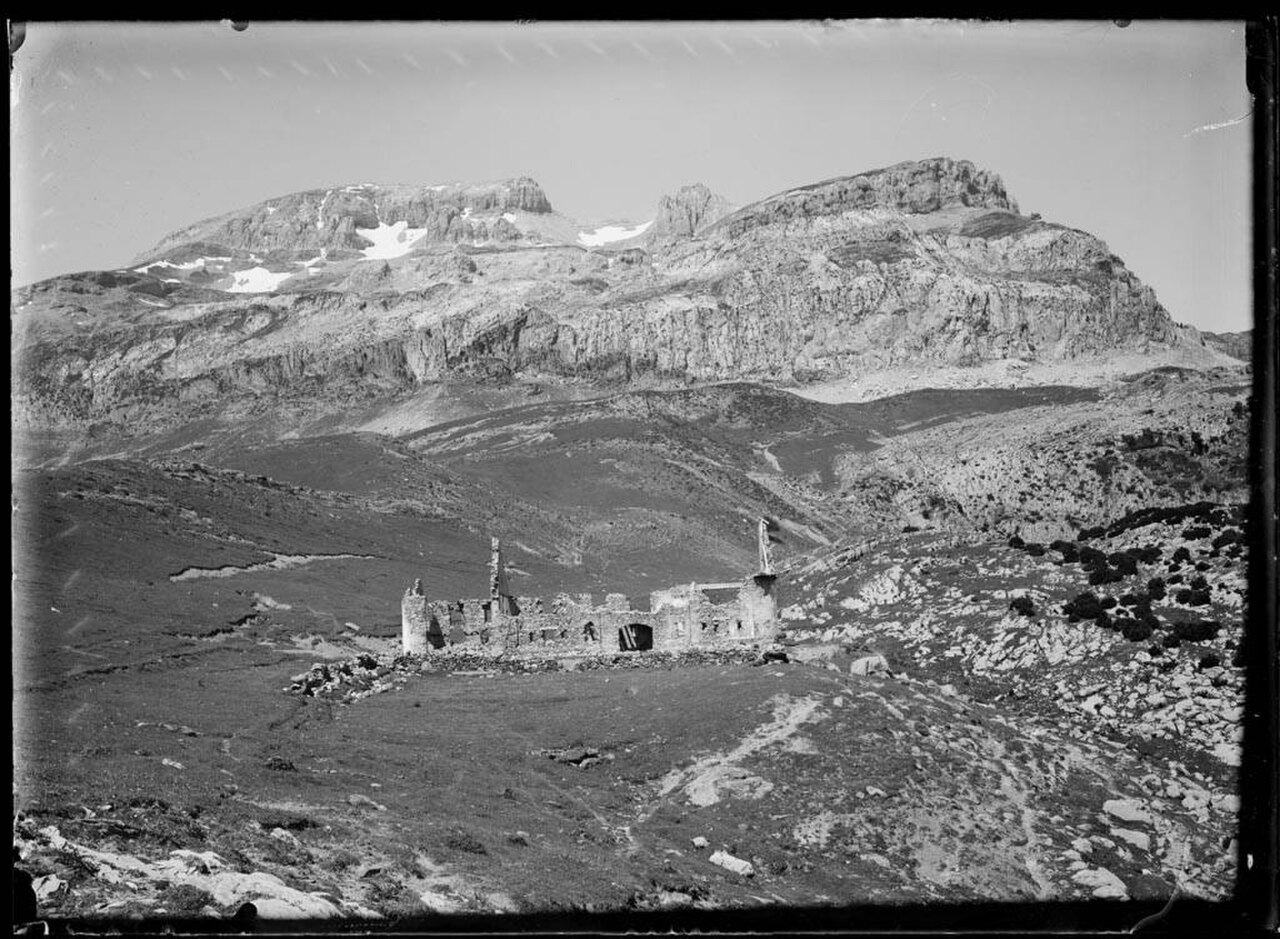
A photograph by Juli Soler i Santaló, taken in August 1910 and held in the Centre Excursionista de Catalunya archives, shows the Bisaurín summit above the ruined Carabineros barracks on the Lízara plain.
At the northern edge of the same plain, at the rocky foot of the Chorrota, the Aragón Cultural Heritage Register records a prehistoric megalith known as the Dolmen de Lízara. It survives as a circular earthen and limestone mound roughly 15 m across and 1.5 m high, with a low rectangular chamber oriented open to the west, built from limestone and sandstone slabs. The catalogue places its date within a late prehistoric range spanning the Neolithic to the Chalcolithic. The barracks ruins photographed in 1910 and the dolmen mound are separate physical traces occupying the same plain across a very large span of time.
A Cave Beetle of the Bisaurín Massif
In 2007, entomologists Javier Fresneda and Jordi Comas described a beetle species, Bathysciola fadriquei, collected from subterranean cavities within the Bisaurín massif. The type locality — the specific place from which the specimen that serves as the formal reference for the species was obtained — is the Cueva de Lizara, recorded at an elevation of 1,470 m, where a specimen from the type series was captured in 2006.
The Natural Sciences Museum of Barcelona catalogue also records the species from a second cavity, the Espelunga de Mediodía in the Sierra de Bernera, likewise within the massif. The description of Bathysciola fadriquei adds a subterranean biological dimension to the karst limestone terrain that defines Bisaurín's geology above ground.