
Coral Rock and Raised Ground
The hills belong to the Mokmer Formation, the younger of Biak's main limestone units, mapped across the eastern half of the island by a 2020 geological study led by Alviyanda, Gusti Muhammad Lucki Junursyah and Prihadi Sumintadireja. Field observations recorded outcrops of coral limestone overlying chalky limestone, with coral fragments, algae, molluscs and planktonic foraminifera preserved in the rock, all evidence of marine deposition. Government geological synthesis of the broader Biak Basin describes a late Pleistocene reversal from subsidence to uplift, with intermittent raised steps preserved as the coastal terrain visible today.
A 2020 survey measured electrical properties of rock at 25 points across East Biak, allowing geologists to model five subsurface units beneath the region. Those units resolve into two broad sequences, both dominated by carbonate rock.
Karst Drainage Beneath the Hills
The Indonesian landform atlas distinguishes the limestone hills of Biak from the flatter coastal plain that fringes much of the island. Rainwater can seep into cracks in the limestone and travel through cavities underground, a process typical of this kind of terrain. Where such a subsurface channel meets an opening at the base of a hill, water can re-emerge as a spring.
Hill Forest and Its Birds
A 2023 study by K. David Bishop and Sebastianus van Balen documented surviving primary forest in the rough limestone hills of northwestern Biak Island. The researchers recorded the Biak Monarch, Symposiachrus brehmii, on both Biak and the neighbouring island of Supiori. They suggested the species may favour the hill forest habitat found across this limestone terrain.
On 8 April 1982 a decree by the Indonesian agriculture minister designated the North Biak Nature Reserve in the far north of the island.
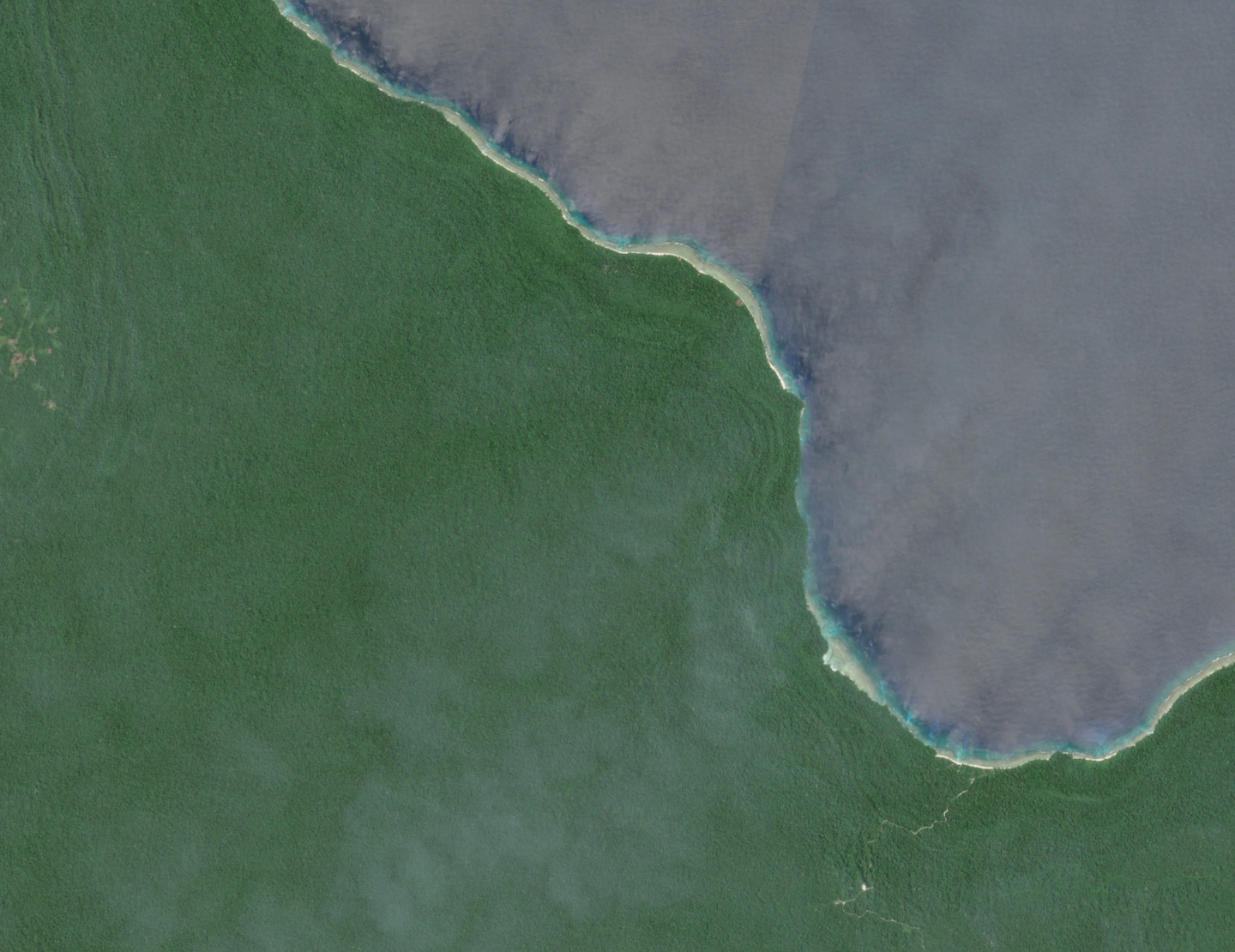
Limestone hills and coastal inlet, northeastern Biak
A Sentinel-2C image from 23 August 2026 shows forested low limestone hills covering most of the scene, with the pale coastal fringe curving around the inlet on the right. Contains modified Copernicus Sentinel data 2026.