
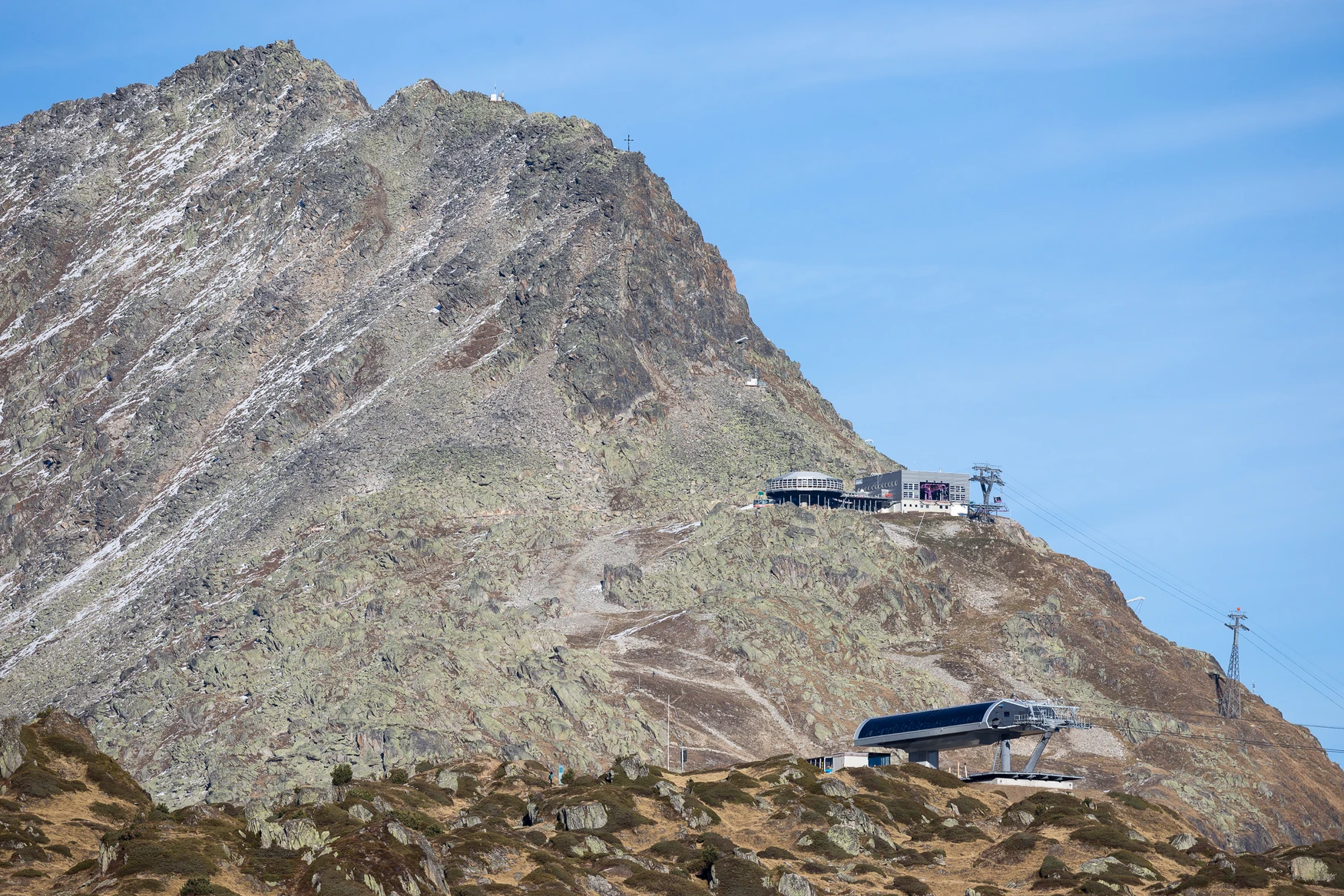
The crest above the glacier
Swisstopo’s gazetteer locates the main summit at the higher of the two points. The crest continues northeast towards Eggishorn. The Swiss Alpine Club archive lists the south-west and north-west approaches as T4, an alpine hiking grade, and documents the crossing along the ridge.
The upper gondola station sits at 2,647 m on the shoulder below the crest. In the cover photograph it is set against the bare rock, with the Moosfluh station lower in the foreground.
From Bettmeralp to Bettmergrat
A cableway reached Betten village in 1951, and a second section brought passengers up to Bettmeralp by Christmas of the same year. According to the federal inventory, the separate gondola from Bettmeralp to Bettmergrat dates to 1977. It was replaced in 1995.
The viewpoint near the upper station opens onto the bend in the Great Aletsch Glacier. The landscape around it forms part of the Swiss Alps Jungfrau-Aletsch World Heritage site, first inscribed in 2001 and extended in 2007.
The Grosses Gufer Rock Glacier
Rock falling from the fractured crest near Elselicka feeds Grosses Gufer, the rock glacier on the north side of the Eggishorn–Bettmerhorn ridge. Bruno Messerli and Max Zurbuchen compared photographic surveys from 1950 and 1962. In their 1968 report they found that individual surface blocks near the lower tongue had shifted about 7 to 9 metres over 12 years. The front itself barely advanced, and they found little change in total volume.
Downhill, the Great Aletsch Glacier has a separate record stretching back to 1870. These measurements track shifts in the end of a valley glacier. The Grosses Gufer study measured the movement of individual rocks on the surface of a debris body.