
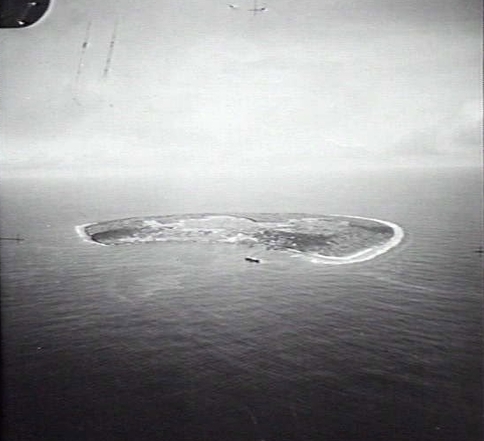
A reef lifted above the sea
In the Royal Australian Air Force’s wartime aerial photograph, a narrow, pale fringe of limestone gives way to a broad interior behind the coastal cliffs. A vessel lies at anchor in Home Bay. That interior is composed of limestone outcrops and pinnacles — formations described in a 2016 field study by R. R. Thaman and Malosi Samuelu published in Atoll Research Bulletin No. 609. The terraces and pinnacles consist of ancient reef limestone raised above the sea.
Phosphate Extraction and the Land
Industrial phosphate mining began on Banaba in 1900 and continued until 1979. Mining removed soil and phosphate from the hollows between the limestone pinnacles. The bare rock left behind made earlier forms of cultivation difficult over much of the interior. Material extracted from Banaba was shipped for use in Australian and New Zealand agriculture. Te Papa Tongarewa records the loss of local food trees and the contested terms under which mining proceeded.
The 2016 Thaman and Samuelu study found that by the time of their fieldwork some Banabans were growing cassava in staple-food gardens established between mined-out pinnacles.
Displacement and Continued Presence
In 1945, following wartime occupation and the dispersal of the Banaban population, the community was forcibly relocated to Rabi Island in Fiji — a removal that occurred within the longer history of colonial phosphate extraction on Banaba. Some Banabans maintained or later re-established a presence on Banaba itself, and the island remains part of Kiribati.
Banaban people have continued to assert their relationship to the island through culture, law, and performance. An exhibition, Dance Protest: Project Banaba, by Banaban-descended artist Katerina Teaiwa — presented at the Chau Chak Wing Museum — documents how song and dance sustained Banaban cultural identity and also served as instruments of protest. During litigation in the 1970s over the consequences of mining, Banaban dancers led some of the associated protest marches.