
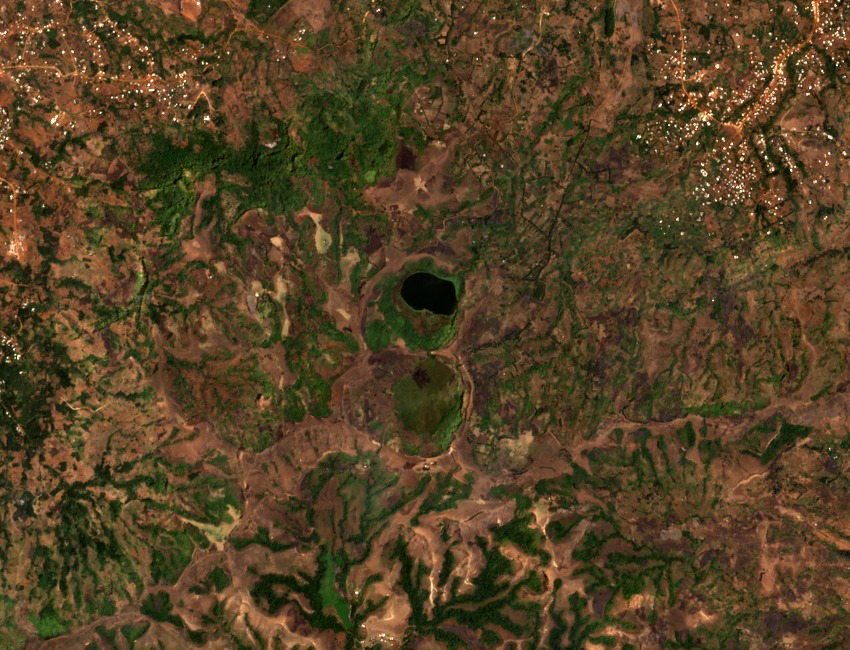
Sediment Record from the Lower Crater Lake
A 13.5-metre sediment core recovered from the lower crater lake, reported by researchers at the University of Liège in 2008, preserves pollen grains spanning thousands of years. The record indicates that montane forest expanded around 14,080 calibrated years before present, with Myrica among the pioneering taxa identified in the pollen sequence. The University of Minnesota has separately published preliminary evidence from Bambili sediments using radiocarbon chronology extending to approximately 24,000 radiocarbon years, a distinct time unit from the calibrated estimate.
Upper Crater Marsh and Owl Pellet Study
The upper crater retains wetland vegetation where a former lake has transitioned to marsh. In November 2001, field researchers conducted an ecological study within the Bambili volcano craters, examining owl pellets collected at the upper crater marsh. That work, published in the African Journal of Ecology, documents faunal composition at the site and treats the two crater habitats as ecologically distinct rather than as a single uniform environment.
Vegetation History and Highland Context
IntechOpen chapters drawing on the Bambili pollen archive place the twin-crater site within the broader vegetation history of the Bamenda Highlands. The pollen assemblages recovered from crater sediments reflect changes in montane forest composition over millennia. The site's dual-crater geometry and the preservation quality of its organic sediments have made Bambili a focus of collaborative palaeoenvironmental research across multiple institutions.