
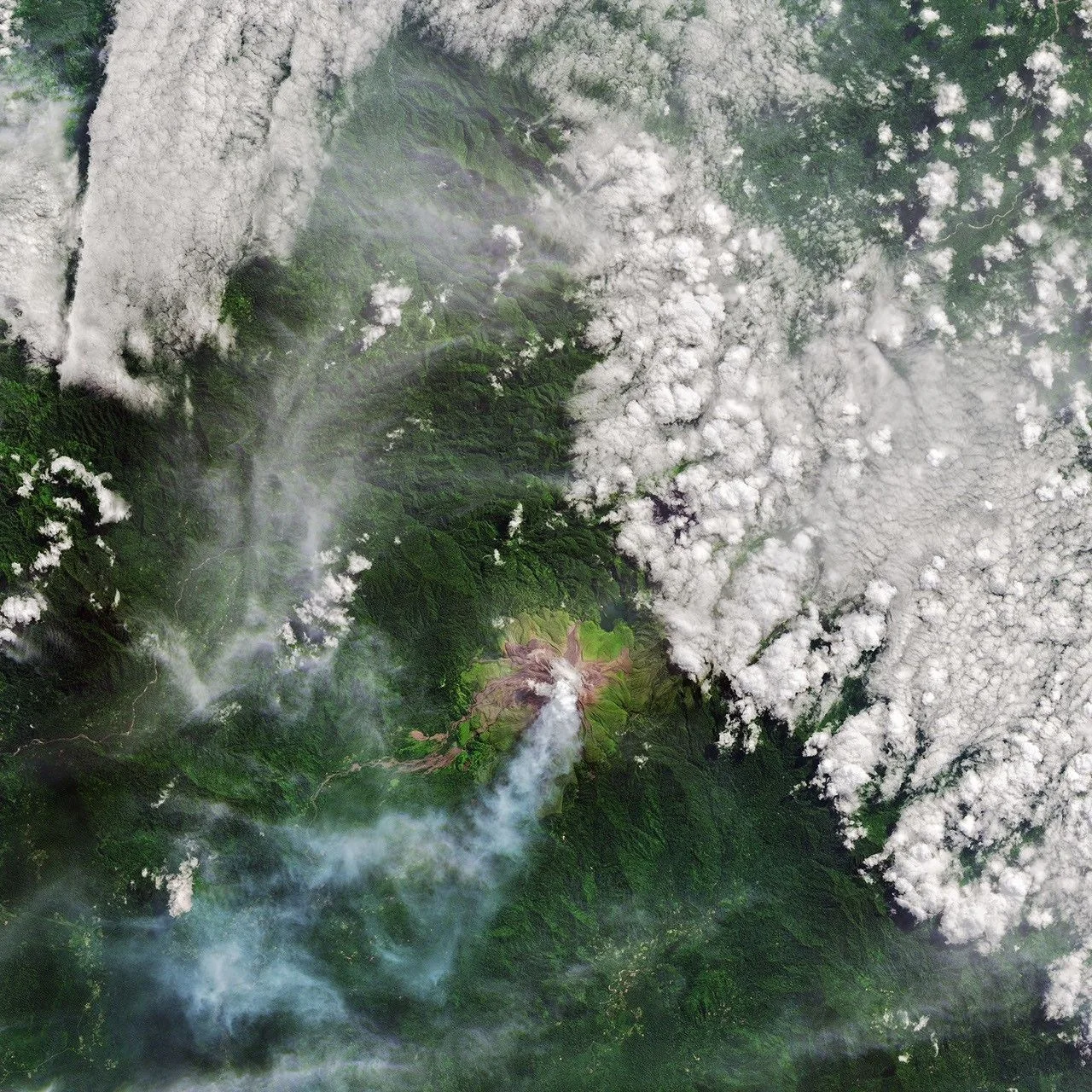
A Cone Built Flow by Flow
Bagana is composed predominantly of viscous andesitic lava, piled up through repeated effusive episodes rather than through the explosive events associated with many stratovolcanoes. Scientists have estimated that at its present rate of lava production the entire cone could have been assembled in roughly 300 to 500 years — a figure derived from observed output rates, not a radiometrically determined formation date. The result is a structure whose steep flanks record each successive flow in their very shape.
Lava Flows, Lobes, and a Summit Dome
Descending Bagana's flanks on all sides are tongue-shaped lava lobes reaching up to 50 metres in thickness, their margins defined by prominent levees — raised ridges of cooled, blocky lava that form as the slower-moving edges of a flow solidify while the interior continues to advance. Within the summit crater, effusive activity sustains a small lava dome, a mound of solidified viscous lava distinct from the fluid lava lakes seen at other volcanoes. Occasional explosive episodes can generate pyroclastic flows, but the dominant character of Bagana's activity is this steady, non-explosive outpouring of thick lava.
Reading Eruptions from Orbit
Because Bagana sits in a remote and densely forested part of Bougainville, sustained ground observation is difficult, and researchers have turned to satellite data to study its behavior. A 2019 study combined satellite measurements of sulfur dioxide emissions with thermal infrared flux readings to distinguish active eruption episodes from quieter intervals — periods during which gas emissions persist even as surface lava output pauses. That pairing of chemical and thermal signatures has helped scientists characterize the rhythm of Bagana's activity without requiring a continuous presence at the volcano.