
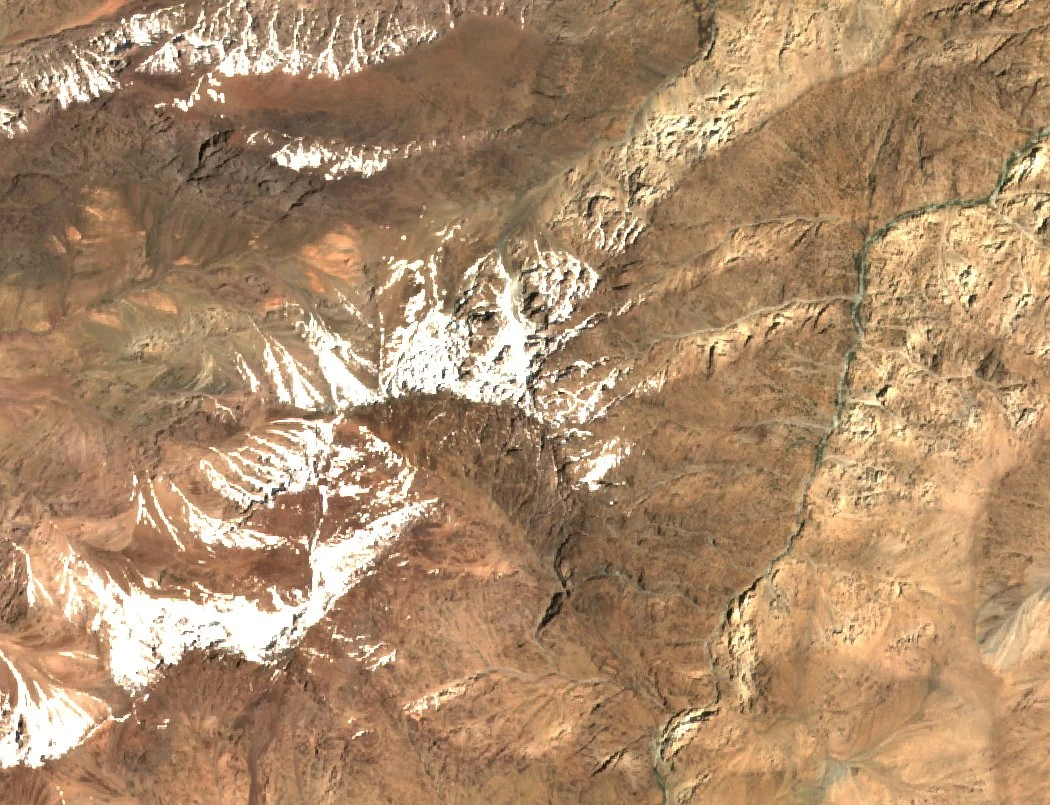
Two summits above Tacheddirt
The ridge rises above the upper Imnane Valley and the village of Tacheddirt. The Moroccan biodiversity portal lists Ineghmar among the watershed peaks of Toubkal National Park. Hughes and coauthors place the mountain just over 2 km northeast of Bou Iguenouane. The Ice-X Alpine Club records two summit points here, the 3,892 m east summit and the 3,885 m west summit.
Snow in the north-face cirques
Two cirques open on the north face of Annrhemer. These steep, amphitheatre-shaped hollows were cut by former glaciers. Hughes and coauthors mapped patches of late-lying snow in both cirques, with the longest-lasting accumulation at around 3,600 m on the eastern side. The team compared Annrhemer with other shaded high-altitude sites where snow can survive into summer.
What the snow surveys recorded
In August 2016, a snow patch covered approximately 1,800 square metres on Annrhemer. The study recorded about 530 square metres at the Tazaghart Névé Permanent site that same month. At an October 2013 observation on Annrhemer, the researchers saw no remaining snow. The dates are snapshots of different stages of summer melt in different years. They show how much the appearance of the north face can vary between observations.
A ridge traverse in 1961
A September 1961 expedition to the Toubkal massif included a solo traverse of Annrhemer by Wilfred Noyce. He recorded the spelling Anrhemer and a height of 3,893 m in the Association of British Members of the Swiss Alpine Club’s 1962 journal. Noyce ascended the west ridge and descended the northeast ridge. His intended companion Len Frank fell ill during the expedition and missed the climbs.