
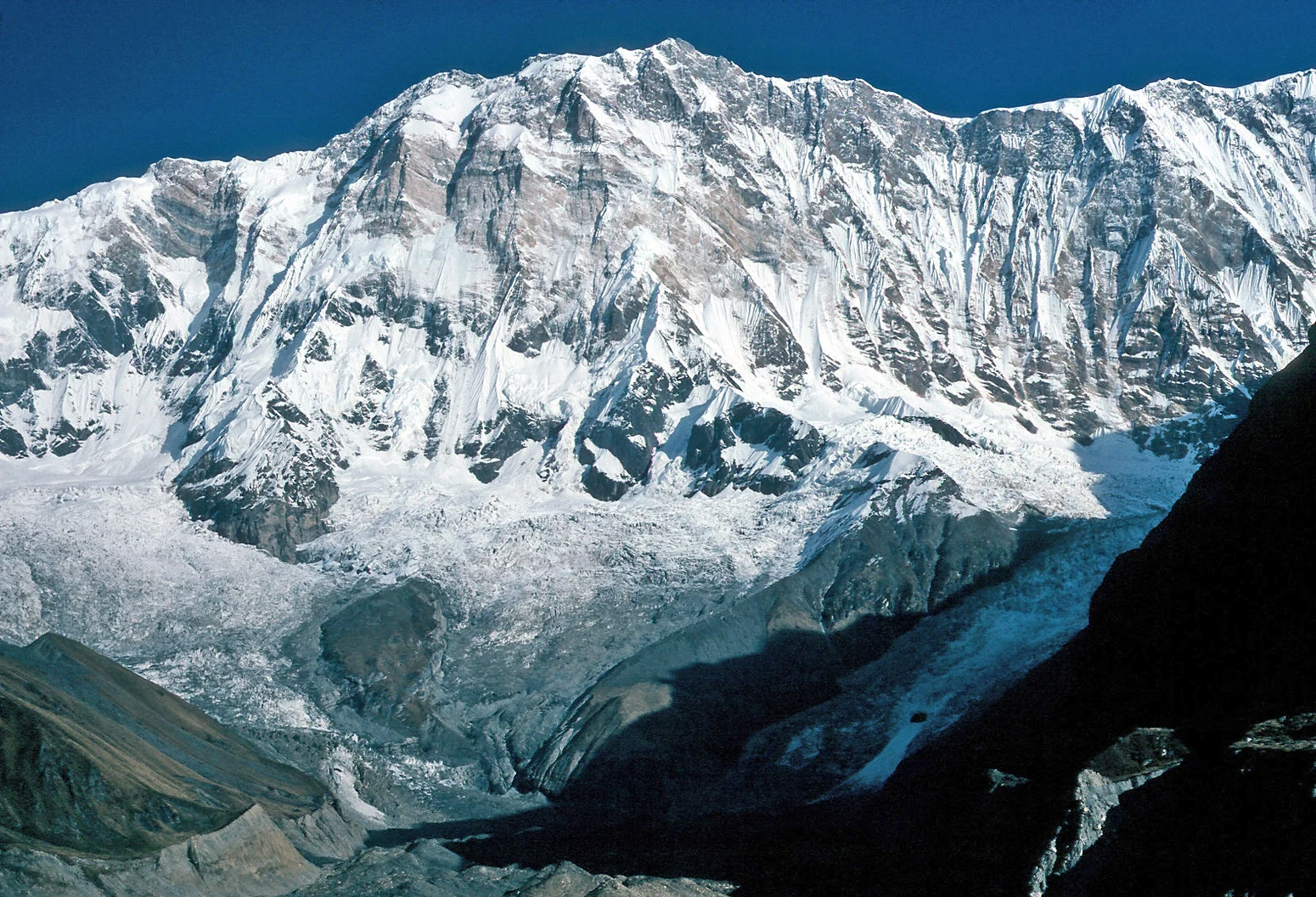
The First 8,000-Metre Summit
On 3 June 1950, Maurice Herzog and Louis Lachenal reached the top of Annapurna I via the north face, completing the first ascent of any mountain above 8,000 metres. The achievement came at severe cost: both climbers suffered extreme frostbite during the descent, an outcome that would shadow accounts of the climb for decades. The 1950 expedition had initially studied Dhaulagiri before shifting its objective to Annapurna, and the north face route they ultimately followed bears no relation to the south face line that would be pioneered two decades later by an entirely different team.
A separate milestone was recorded on 13 October 1977, when Sonam Wolang Sherpa became the first Nepali citizen to reach the summit, an achievement credited in the account of Nepal's Tourism Board as a distinct landmark in the mountain's history.
The South Face and the 1970 Expedition
By the late 1960s, the unclimbed south face of Annapurna I had attracted attention as one of the great unsolved problems in Himalayan climbing. Chris Bonington, who had seen the great face from the summit ridges of Annapurna II during a 1960 climb, led the 1970 expedition that set out to climb it. Tom Frost, a member of that expedition, later published a firsthand account of the undertaking in the American Alpine Journal.
Don Whillans and Dougal Haston reached the summit on 27 May 1970, completing the first ascent of the south face. Frost's expedition roster lists Pasang Kami as sirdar and records Kancha, Ang Pema, Pemba Tharkay, Mingma Tsering, and Nima Tsering among its members.
The Annapurna Conservation Area
The mountain sits within a broader landscape that extends far beyond its climbing faces. The Annapurna Conservation Area, established under the National Trust for Nature Conservation's Annapurna Conservation Area Project beginning in 1986, covers 7,629 square kilometres and stands as Nepal's first designated conservation area. Within its boundaries the Kali Gandaki gorge cuts through terrain where Tethys Sea fossils document the ancient ocean floor that once occupied this part of the Himalaya, while the forests around Ghorepani are known for their rhododendron growth.
The communities living across the Annapurna Conservation Area speak different languages and represent distinct cultures — a diversity that the National Trust for Nature Conservation has placed at the centre of its conservation approach, recognising that the long-term viability of the area depends on the participation of these communities.