
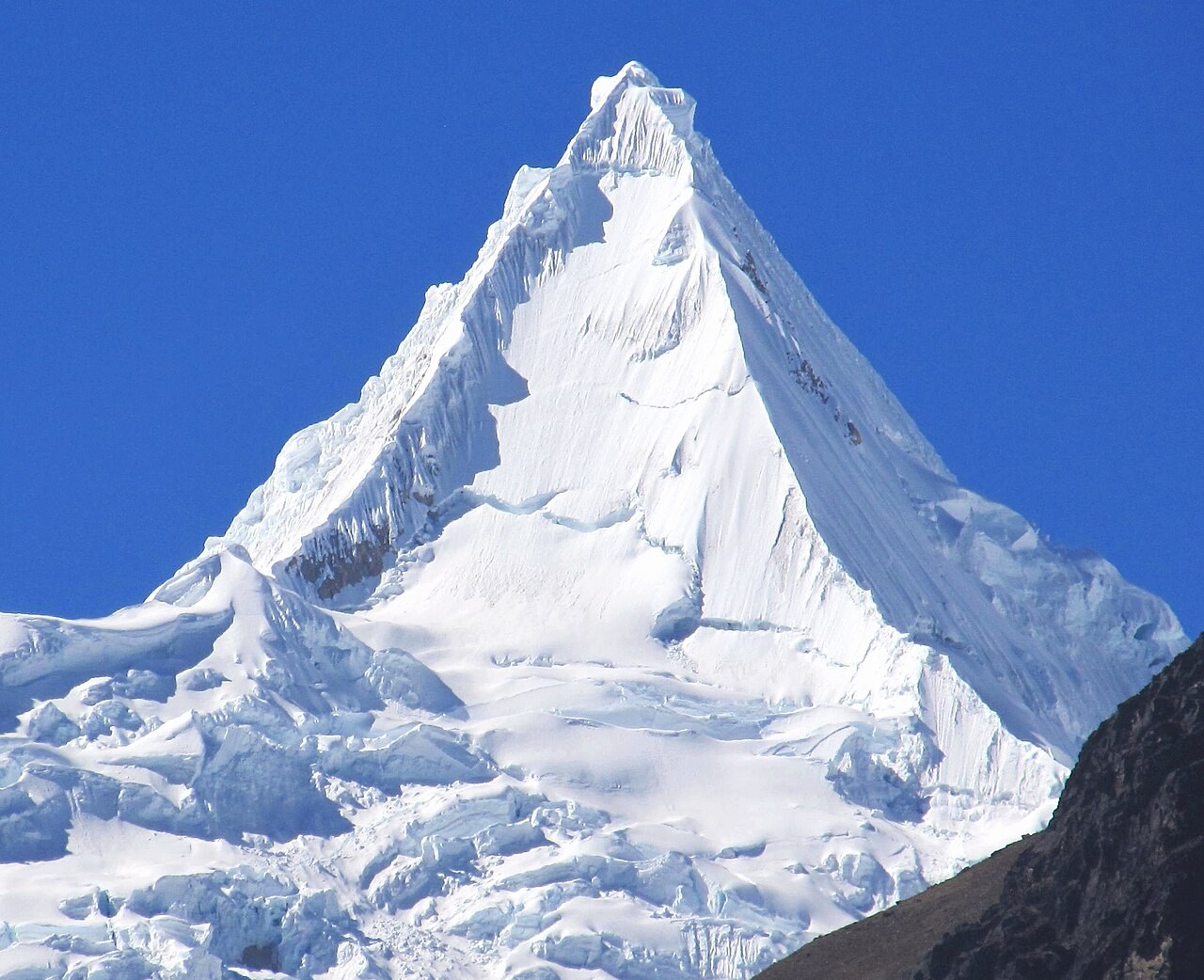
Form and geometry of a singular summit
What sets Alpamayo apart from other snow peaks of the Cordillera Blanca is the configuration of its southwest face: an ice pyramid furrowed by vertical channels — known as flutes — which, seen from the summit of Quitaraju or from the moraines of the glacial cirque, produce an image of almost architectural symmetry. The Alpine Journal described Alpamayo in 1967 as "the most beautiful mountain in the world," though the source itself clarifies that this is an unofficial title. The silhouette changes completely when the summit is circled: from the north or the east the profile loses that characteristic symmetry and presents more irregular ridges, underscoring just how much the mountain's visual fame is tied to a specific angle of view.
History of ascents
The first confirmed ascent of Alpamayo took place in 1957 and was accomplished by a German expedition comprising G. Hauser, B. Huhn, F. Knauss, and H. Wiedmann, as recorded by both Andeshandbook and the Alpine Journal. Eighteen years later, in 1975, the team led by Casimiro Ferrari completed the first ascent of the southwest face, an alpinistic achievement distinct and independent from the conquest of the summit: climbing that specific wall posed its own technical problems arising precisely from the fluted ice geometry that makes Alpamayo so recognizable from a distance.
The American Alpine Club documented both achievements in its publications, and SERNANP recognizes Alpamayo as part of the climbing heritage that justifies the protection of Huascarán National Park alongside other neighboring massifs. The coexistence of historical expedition records from the mid-twentieth century with the current management of the protected natural area illustrates how mountaineering memory and territorial conservation overlap in the Cordillera Blanca.
Alpamayo within its protected setting
Huascarán National Park, administered by SERNANP, encompasses the entirety of the Cordillera Blanca above approximately 4,000 metres, an area in which Alpamayo shares the stage with a constellation of snow peaks in the Santa Cruz and Quitaraju group. Inclusion in the park means that any activity on its glaciers takes place within a management framework that combines the protection of high-mountain ecosystems with recognition of a tradition of mountaineering exploration dating back at least to the 1950s. The American Alpine Club bibliography and the records of Andeshandbook constitute the most detailed primary sources for following the chronology of ascents in this part of the park.