
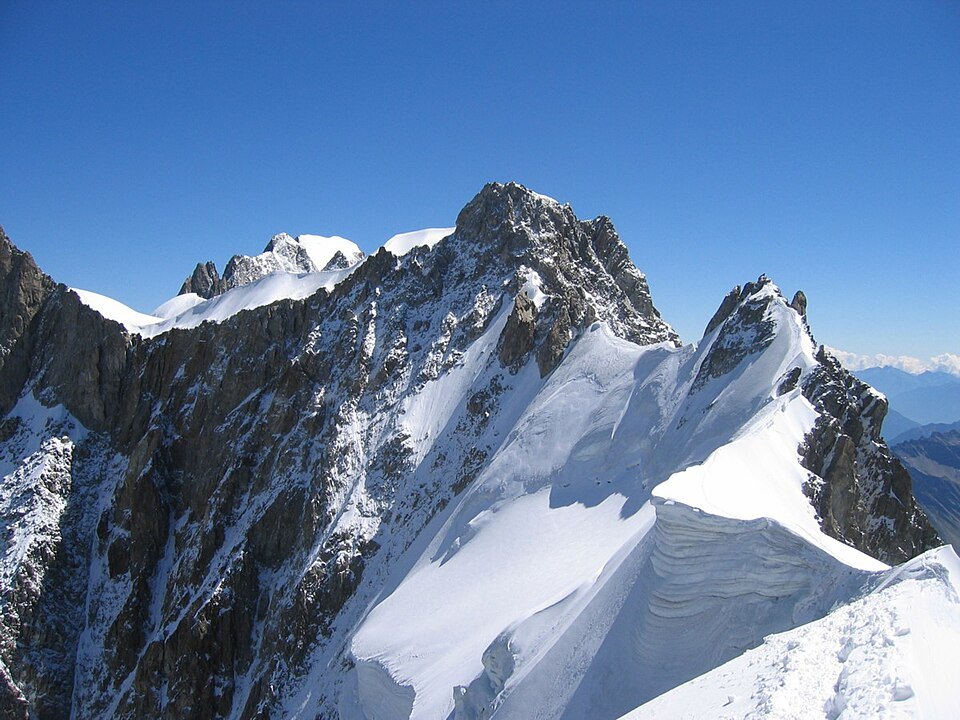
A pivotal position in the Mont Blanc massif
The Aiguille de Rochefort does not assert itself through exceptional height — its 4,001 meters place it just barely above the four-thousand-meter threshold — but through the singularity of its geographical position. It stands precisely between the Grandes Jorasses, a massif of vertiginous walls, and the Dent du Géant, a characteristic granite tower. This position gives it an identity of its own: a transitional summit, it articulates two of the most frequented ridgelines in the Mont Blanc massif.
The Franco-Italian border runs along this ridge, dividing the summit between Haute-Savoie on the French side and the Aosta Valley on the Italian side. This administrative duality reflects a high-mountain geography in which watersheds follow political boundaries, tracing a landscape that is at once natural and symbolic.
The Torino refuge as a base point
The approach to the Aiguille de Rochefort passes through the Torino refuge, situated at 3,375 meters above sea level. This refuge constitutes, according to the available field notes, the natural starting point for tackling the summit. Its elevated position on the Italian side of the massif allows climbers to set out from a base already committed to high mountain terrain, reducing the vertical gain needed to reach the summit's 4,001 meters.
A summit in the constellation of four-thousanders
The Aiguille de Rochefort appears on the UIAA's official list of Alpine four-thousand-meter summits. In this demanding nomenclature, it represents one of the high points of the Mont Blanc massif which, taken together, constitute the greatest concentration of summits in this category in Europe. Its precise elevation — 4,001 meters — makes it one of the least elevated members of this group, but also one of the most precisely situated on the very borderline of the four-thousander definition itself.