
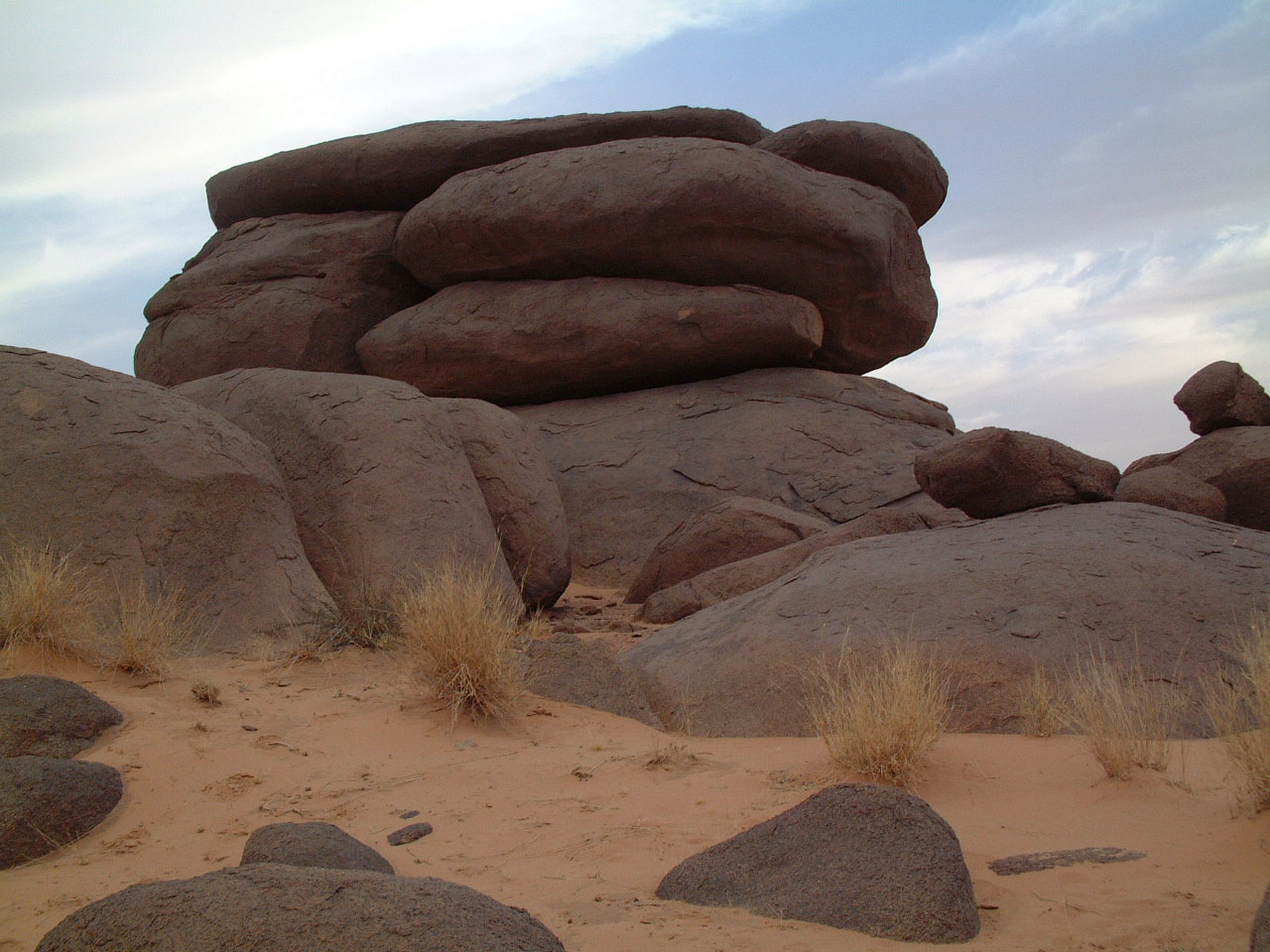
Basement Lithologies and the CNRS Gravity Survey
A gravity survey conducted jointly by CNRS and the Malian geological agency mapped distinct basement lithologies across the massif, recording measurable lateral changes in gravitational acceleration. These variations reflect differences in rock density among the exposed Precambrian formations, providing a subsurface structural picture of a terrain where bedrock composition shifts across relatively short distances.
Field Methods of the IRD Mammal Inventory
An IRD field inventory of the Adrar des Ifoghas assembled mammal records through three complementary methods: direct visual observation, live-trapping, and analysis of raptor pellets and nest remains. The pellet analysis proved particularly productive for small insectivores, revealing shrew species that live-traps had not captured, demonstrating how the two approaches document different segments of the mammal community.
Thirteen Rodent Species Across Five Families
The inventory recorded thirteen rodent species distributed among five families from sites ranging from settlement-adjacent areas to less inhabited wadis. Among the documented species are Massoutiera mzabi, a gundi associated with rocky outcrops, and Jaculus jaculus, a desert-adapted jerboa. This distribution across habitat types reflects the ecological range the massif offers to small mammals of the central Saharan zone.