
Correction, 9 November 2026. Our earlier version incorrectly said that the climbers of 1934 died. Willy Beck and the Löwinger brothers all survived. The first fatalities were Karl Mehringer and Max Sedlmayr in 1935. We have corrected the headings and summary and reviewed the equipment and biographical details of the 1938 ascent.
What the Eiger North Face is
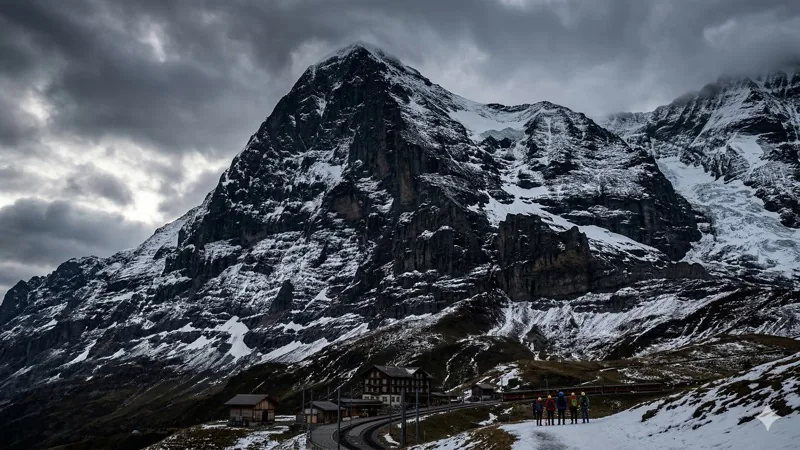
The Eiger (3,967 m) rises out of the Bernese Alps in Switzerland. With the Jungfrau and the Mönch, it forms the famous trio of Bernese summits — and on its north side, the mountain drops away in a single immense rock face roughly 1,800 m high. This is the Eigernordwand: the north face of the Eiger.
Together with the north faces of the Matterhorn and the Grandes Jorasses, it is counted as one of the three great north faces of the Alps. In German, climbers gave it a darker name — playing on the spelling of Nordwand ("north face") to call it Mordwand ("murder wall"). Built largely of fragile limestone, the face is famous for rockfall and for sudden, total changes in the weather. In the 1930s, the contest to make the first ascent of this wall produced one of the most harrowing stories in the history of alpinism.
The first attempts, the first dead — 1934–1935
1934 — three climbers return alive
In July 1934, the Germans Willy Beck, Kurt Löwinger and Georg Löwinger attempted the north face. After reaching about 2,900 m, they abandoned the climb following a fall by Beck and escaped through a tunnel of the Jungfrau Railway. All three survived.
1935 — the first fatalities and the death bivouac
In August 1935, the Munich climbers Karl Mehringer and Max Sedlmayr attempted the north face and died during severe weather. They were the first climbers to lose their lives while attempting the face.
A location near the Third Icefield that they reached became known as the Todesbiwak, or death bivouac. Contemporary accounts contain uncertainty about the precise sequence of events and the causes of their deaths.
The attempts were followed through telescopes from below, making spectatorship a distinctive part of the history of the Eiger north face. The disasters of 1935 and 1936 attracted widespread attention.
1936 — the death of four young climbers
The Nazi shadow and the Olympics
1936 was the year of the Berlin Olympics. A contemporary Alpine Journal report says the climbers were conscious of an Olympic medal for that year’s outstanding mountaineering achievement. That report alone cannot establish each climber’s motives. After the successful ascent in 1938, the Nazi regime exploited the achievement for propaganda.
Four challengers
In July 1936, two pairs began up the face. From Germany, Andreas Hinterstoisser and Toni Kurz. From Austria, Edi Rainer and Willy Angerer. All four were in their twenties — gifted, strong, and ambitious.
The two pairs met on the wall and joined forces. Hinterstoisser solved the smooth, near-vertical slab below the First Icefield with an audacious pendulum-traverse on a fixed rope — a piece of technique that would go down in climbing history as the Hinterstoisser Traverse.
Retreat — and despair
When Angerer was hit by rockfall, the four of them decided to descend. That was when the fatal mistake revealed itself: they had pulled the traverse rope down after themselves on the way up. Reversing the traverse over the now ice-glazed slab without a fixed line was simply not possible.
The four sought another way down. Mountain guides approached through a gallery of the Jungfrau Railway, but Hinterstoisser, Angerer and Rainer died during the descent on 21 July. The contemporary report acknowledges that the precise accident sequence could not be established, so detailed causes of death should be treated cautiously.
Toni Kurz's last hours
Kurz survived the night with severe frostbite and exhaustion. The guides had begun their rescue attempt on 21 July and returned on 22 July. Ice-covered rock and overhangs prevented them from reaching him directly.
Using his functioning hand, Kurz prepared a line that reached the guides below. They attached ropes for him to haul up and use for the descent. A joining knot caught in his carabiner, and he could not pass it. Although he had come within reach of rescue, he died before the guides could save him.
A ban on the climb
After the tragedy, the canton of Bern prohibited attempts on the face in July 1936. Legal problems led to the withdrawal of the measure in November that year.
1938 — the wall is finally climbed
1937 — a "successful retreat"
In August 1937, Mathias Rebitsch and Ludwig Vörg climbed beyond the death bivouac before bad weather forced them back. Both returned alive. Their retreat was an important demonstration that climbers could return from the difficulties in the central face.
Two parties meet on the wall
In July 1938, the Austrians Fritz Kasparek and Heinrich Harrer climbed ahead of the Germans Anderl Heckmair and Ludwig Vörg. The pairs began on different days, and the German pair caught up with the Austrians on the face.
The four then climbed as one party. In his own account, Harrer explicitly describes Heckmair and Vörg as better equipped than himself and Kasparek.
To the summit
Heckmair led the difficult pitches. He and Vörg used twelve-point crampons, which helped them on the ice. Harrer’s own account credits the German pair with the superior equipment.
They passed the Hinterstoisser Traverse, the Ramp, the Traverse of the Gods and the White Spider, where snow and rockfall funnelled down the face.
On 24 July, they reached the summit in a storm. Harrer recalls that he and Kasparek had spent 85 hours on the face, and the Germans 61 hours. Harrer, who knew the descent, led the party down the normal route to Eigergletscher.
After the first ascent
Glory hijacked by politics
The achievement could not stay a purely sporting one. The Nazi regime moved immediately to fold the success into its propaganda, and the four climbers were greeted on return by Adolf Hitler personally — a heavily staged piece of political theatre. Years later, Harrer's book The White Spider became the standard published account of the climb itself, and the way most non-climbers know the story today.
What became of the four
After the first ascent, the four climbers' lives went in very different directions.
- Ludwig Vörg — killed on the Eastern Front during the Second World War in 1941.
- Fritz Kasparek — killed in 1954 in Peru, on the northeast ridge of Salcantay, when a cornice collapsed.
- Heinrich Harrer — interned in India during the Second World War, escaped to Tibet and became a tutor to the Dalai Lama. Known for Seven Years in Tibet. He died in 2006, aged 93, the last surviving member of the first-ascent party.
- Anderl Heckmair — worked as a mountain guide after the war. He died in 2005, aged 98.
Landmark ascents that followed
Even after 1938, the Eiger north face kept drawing climbers from around the world.
- 1947 — Lionel Terray and Louis Lachenal make the second ascent.
- March 1961 — first winter ascent of the north face.
- August 1965 — Mitsumasa Takada makes the first Japanese ascent.
- Summer 1969 — Takio Katō, Michiko Imai and Hirobumi Amano open the "Japanese Direct" route.
- March 1978 — Tsuneo Hasegawa makes the first solo winter ascent.
Summary
The three climbers of 1934 returned alive. Mehringer and Sedlmayr died in 1935, followed by Kurz and his three companions in 1936. Attempts continued until a combined party of four completed the first ascent on 24 July 1938. The climbers involved and the fatalities in each attempt need to be distinguished when recounting that history.
The 1936 lesson of the Hinterstoisser Traverse — that you must keep a working retreat — remains a basic principle of climbing today. And the way political and media pressure shaped the climbers' decisions on the wall is a story with obvious echoes for anyone climbing under the gaze of a social-media audience now.
References and sources
- Sächsischer Bergsteigerbund, Mitteilungsblatt 3/2009, pp. 36–37 — 1934 attempt and escape via railway tunnel
- Alpine Journal 1936, Accidents in 1936, pp. 369–373 — 1935 fatalities and 1936 rescue
- Alpine Journal 1938, Expeditions, pp. 310–311 — first ascent, equipment and descent
- Heinrich Harrer, Friends for a Lifetime, Alpine Journal 2005, pp. 245–249 — first-hand account
- Alpine Journal 2006, Heinrich Harrer 1912–2006, pp. 387–390 — biographies and political context
- Daniel Anker and Rainer Rettner, Eiger-Chronik von 1252 bis 2013 — reproduced chronology
- American Alpine Journal 1970 — Japanese Summer Direttissima
- Schweizer Alpen-Club SAC — Eiger, 3967 m